Species Spotlight: Great Grey Owl
By Kevin Pepper |
Introduction of the Species
The Great Grey Owl isn’t loud. It doesn’t scream through the forest like a hawk or chatter like a jay. It appears—suddenly, silently, like smoke drifting between trees—and locks eyes with you. It’s the kind of encounter that halts conversation and steals your breath. For photographers, it’s a dream subject: mysterious, regal, and hauntingly beautiful.
Physical Description of the Great Grey Owl
The Great Grey Owl (Strix nebulosa) is the largest owl in North America by length, up to 33 inches tall—but don’t be fooled by the size. Much of it is fluff. Beneath that thick, feathery cloak is a surprisingly lightweight frame, perfect for silent flight.
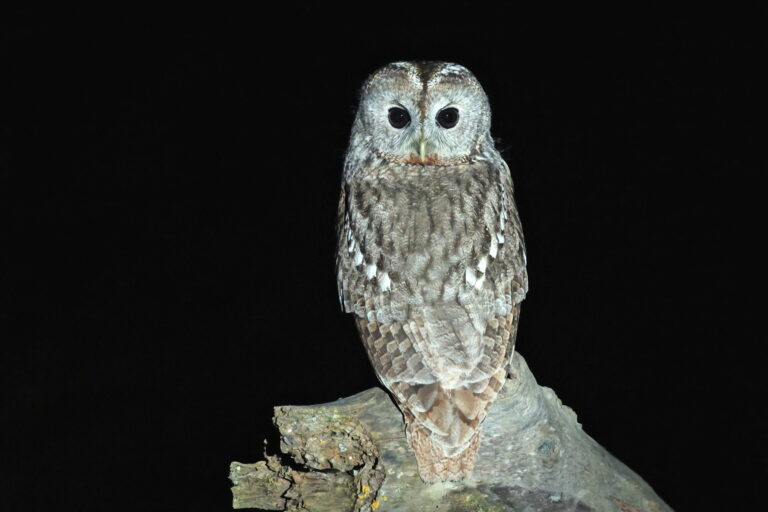
Its facial disk is massive and circular, with concentric grey rings and piercing yellow eyes set in a permanently serious expression. A white “bow tie” mark with a central black dot sits beneath the beak. Its body is slate-grey with fine streaking, and its long tail makes it look even larger when perched.
Physical Variations Amongst the Species
Great Grey Owls are fairly uniform in appearance across their range, though northern individuals may be slightly darker. Immatures are more heavily streaked and appear somewhat fluffier. Unlike many other owl species, males and females look nearly identical, though females tend to be larger, which can sometimes be noticed when seen side by side.
Native Habitat Around the World
Great Grey Owls are found in dense boreal forests, especially near meadows, bogs, and forest edges. Their North American range stretches from Alaska and western Canada through the northern Rockies and into parts of the Upper Midwest. Isolated populations exist in Oregon, California, and the northern Appalachians.
Globally, they’re also found in Scandinavia, Russia, and Eastern Europe, thriving in remote, cold forests with open spaces to hunt.
Who Preys on the Great Grey Owl
As apex predators, adult Great Grey Owls have few natural enemies. Occasionally, they may fall prey to Great Horned Owls, eagles, or lynx. Eggs and nestlings are vulnerable to tree-climbing predators like pine martens and raccoons.
Food/Eating Habits of the Great Grey Owl
These owls are specialists in hunting small mammals, particularly voles and mice. Their hearing is so sensitive, they can locate prey under up to two feet of snow, then plunge down with enough force to break through the crust and snatch it. They rely heavily on sound, often hunting at dusk or dawn from low perches near open clearings.
Watching one hunt is a study in patience and precision—an experience that, when captured well, creates incredibly compelling images.
Known Lifespan
In the wild, Great Grey Owls typically live 8–12 years, although some individuals have been known to survive up to 15 years. In captivity, with protection and consistent food, they can live over 25 years.
Join Us on a Wildlife Workshop
Great Grey Owls are one of the most coveted subjects on our winter wildlife workshops in North America. We photograph them in the boreal forests of Canada and select areas of the northern U.S., where we’ve scouted prime locations and know how to approach with patience and respect.
We’ll help you work with snow, backlighting, and forest compositions to capture images that go beyond the portrait—images that tell a story of winter, silence, and wildness.
Read Other Species Spotlight articles
If you’re as passionate about wildlife as we are, take a moment to explore our Species Spotlight series. Each article dives into the fascinating lives of the animals and birds we love to photograph on our workshops—whether it’s a puffin perched on a cliff in Newfoundland, a leopard draped across a tree in Tanzania, or an Adelie penguin waddling through the snow in Antarctica. It’s a growing library of stories, facts, and inspiration for anyone who dreams of capturing the wild through their lens. Come see the world the way we do—one species at a time.