Species Spotlight: Carpathian Brown Bear
By Kevin Pepper |
Introduction to the Species
Deep within the forests of Romania’s Carpathian Mountains lives one of Europe’s most impressive mammals: the Carpathian brown bear.
Powerful, intelligent, and surprisingly quiet for an animal of its size, a brown bear can emerge from the forest with barely a sound. One moment, the clearing is empty. The next, several hundred pounds of bear are standing at the edge of the trees, examining the scene before taking another step.
Seeing a wild brown bear in Transylvania is memorable. Watching one slowly enter a forest clearing through the viewfinder is something else entirely.
Physical Description
The Carpathian brown bear is not a separate species but a regional population of the brown bear, Ursus arctos, found throughout the Carpathian Mountains.
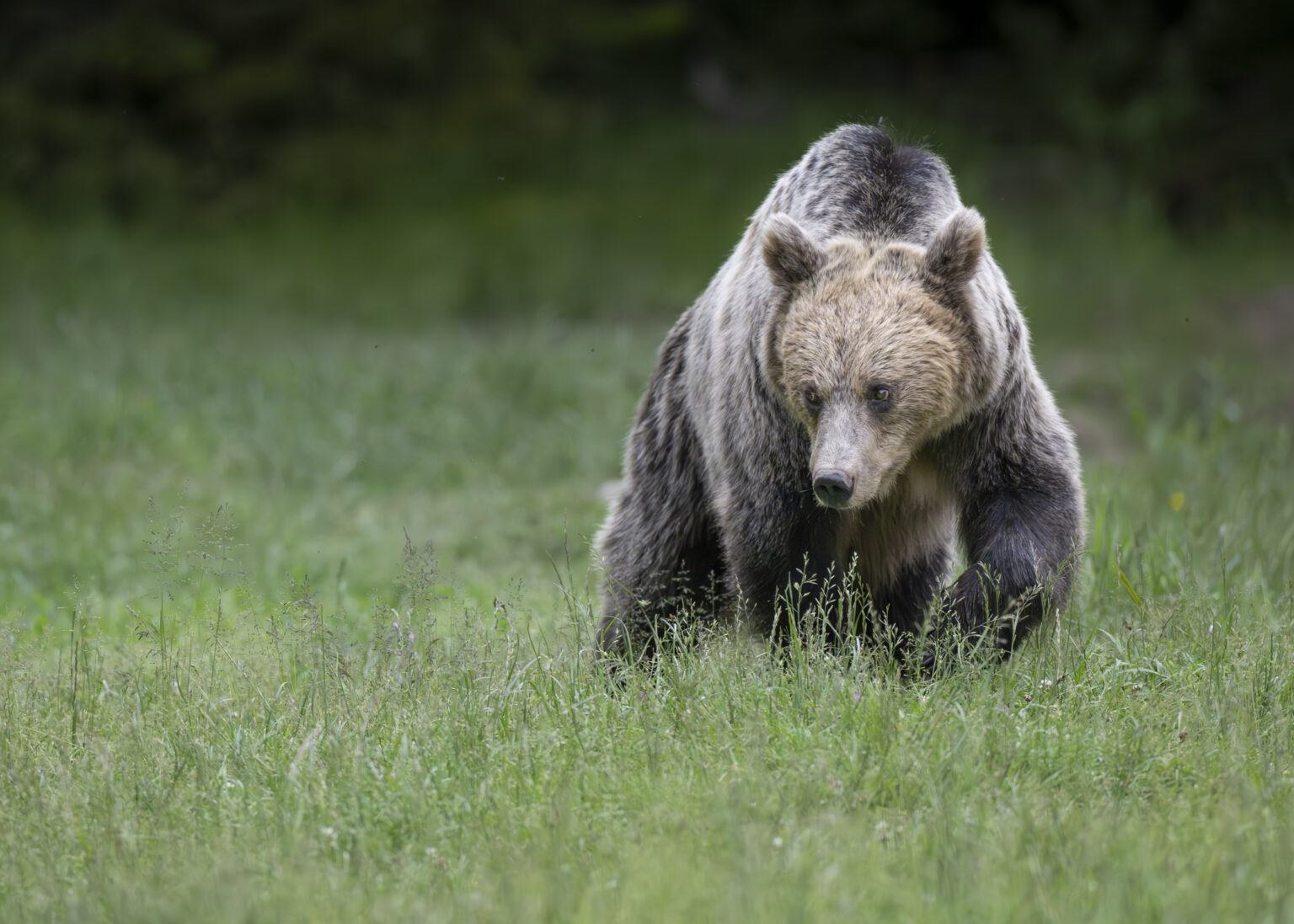
Their thick fur can range from pale brown and golden cinnamon to dark chocolate, with individual bears often displaying lighter colouring around the face, neck, or shoulders. This variation can make each animal surprisingly easy to recognize after spending time observing them.
Brown bears have powerful shoulders, long claws, a broad head, and a muscular body built for digging, climbing, and travelling through steep forested terrain. Adult males are generally much larger than females, although size can vary considerably depending on age, genetics, season, and access to food.
Despite their bulk, brown bears can move quickly and with remarkable grace. They are considerably more athletic than their relaxed walk might suggest—which is a useful fact to remember whenever someone refers to a bear as “slow.”
Native Habitat
The Carpathian Mountains contain some of Europe’s largest remaining areas of suitable brown bear habitat. Dense forests, mountain valleys, meadows, streams, and relatively quiet areas provide the food and shelter bears need throughout the year.
Romania’s bears move across large territories as seasonal food sources change. Their habitat must provide feeding areas, secure winter denning sites, and corridors that allow them to travel between different parts of the mountains.
These forests are also shared with wolves, Eurasian lynx, red deer, roe deer, wild boar, and an impressive variety of woodland birds.
Where They Are Found
Brown bears occur across portions of Europe, Asia, and North America. Within Europe, the Carpathians support one of the continent’s most important brown bear populations.
Romania holds an especially significant portion of that population, with bears concentrated primarily in the forested mountain regions of Transylvania and the Eastern and Southern Carpathians.
The exact number of bears in Romania has been debated, and recent estimates have varied considerably depending on the methods used. What is clear is that the country remains one of the best places in Europe to observe and photograph wild brown bears in their natural environment.
Behaviour in the Wild
Brown bears are generally solitary, although females remain with their cubs and several bears may tolerate one another where food is plentiful.
Much of their time is spent searching for food. A bear may walk slowly through a clearing, investigate fallen logs, dig into the ground, turn over stones, or stand upright to examine an unfamiliar sound or scent.
Standing on the hind legs is not normally an aggressive posture. It allows the bear to see farther and gather more information through its highly developed sense of smell.
Carpathian brown bears adjust their movements throughout the year as food availability changes. Research in Romania has identified distinct seasonal periods connected to winter dormancy, spring movement, summer forest fruits, and intensive autumn feeding.
For photographers, these behaviours can produce far more interesting images than a bear simply looking toward the camera. A raised paw, an alert posture, interaction between cubs, or a bear emerging cautiously from the forest can tell a much stronger story.
Food and Eating Habits
Brown bears are opportunistic omnivores, but much of their diet consists of plant material.
Depending on the season, they may eat grasses, roots, berries, fruits, nuts, seeds, insects, and fungi. They will also consume carrion, small mammals, eggs, and occasionally larger animals when the opportunity arises.
Their diet changes throughout the year. Fresh vegetation becomes important after winter, berries and forest fruits are widely used during summer, and calorie-rich foods become especially valuable in autumn as bears prepare for winter dormancy.
A feeding bear is rarely stationary for long. It may lower its head, move through vegetation, dig with its front paws, or pause briefly to investigate the air. These constant changes in posture provide photographers with a wide range of expressions and compositions.
Winter Dormancy
Brown bears spend the coldest part of the year inside sheltered dens, although their winter sleep is not as deep as the true hibernation experienced by some smaller mammals.
Dens may be located in natural cavities, beneath tree roots, among rocks, or in areas excavated by the bear. Romanian research has shown the importance of protecting quiet, undisturbed forest habitat surrounding traditional denning areas.
Pregnant females give birth inside the den, usually during winter. The cubs are born extremely small, blind, and dependent on their mother.
By the time the family emerges, the cubs are strong enough to follow her—but often still small enough to climb a tree the moment something makes them nervous.
Breeding and Cubs
Brown bears generally mate during late spring and early summer. Through delayed implantation, the fertilized embryo does not begin developing immediately. This allows the birth of the cubs to coincide with the mother’s winter denning period.
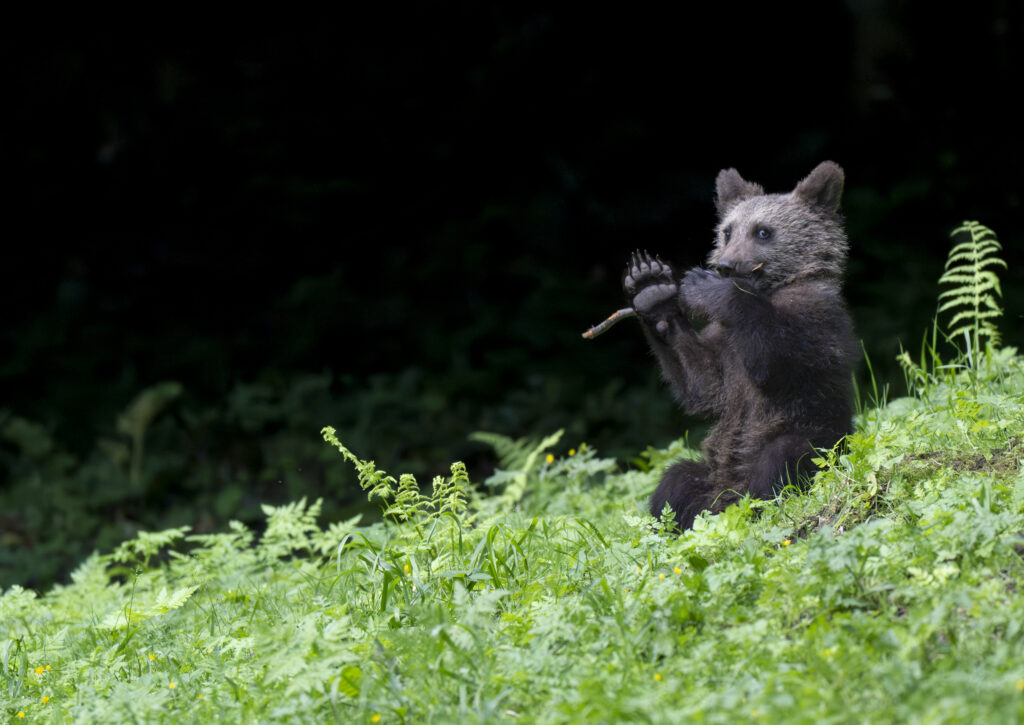
Litters usually contain one to three cubs, with two being common. The cubs remain with their mother for roughly two or more years, learning where to find food, how to move through their territory, and how to recognize potential danger.
Family groups provide some of the most engaging photographic opportunities. Cubs may wrestle, chase one another, climb trees, copy their mother’s behaviour, or wander slightly too far before realizing they have been left behind.
A mother with cubs also demands respect. Her first priority is their safety, and all observation and photography must be conducted responsibly from secure locations without altering the bears’ natural behaviour.
Why Photographers Love Them
Carpathian brown bears offer a combination of power, personality, behaviour, and atmosphere.
The dark Transylvanian forest creates a natural stage. A bear may appear between tree trunks, cross a patch of soft light, pause beside a moss-covered log, or emerge into an open meadow with the mountains behind it.
Every animal looks different. Older males carry the weight and scars of years in the forest. Females are often more cautious and attentive. Cubs provide energy, unpredictability, and occasional comedy—usually at their mother’s expense.
The challenge is not simply to photograph a bear. It is to capture the feeling of seeing one appear from the Carpathian forest.
Photography Tips
Light levels in the forest can be low, so photographers should be prepared to use higher ISO settings and wide apertures. A fast shutter speed is important when bears are walking, running, playing, or interacting.
Focus on the eyes when possible, but also pay attention to the surrounding habitat. A close portrait can be powerful, yet an environmental image showing a bear beneath the towering forest often provides a stronger sense of place.
Watch the edges of the trees. Bears frequently pause before entering an open area, and these first moments can create dramatic images. Be ready when cubs begin interacting, when a bear raises its head to scent the air, or when soft light reaches the face.
Above all, remain patient. The forest operates on the bear’s schedule, not ours. Bears have apparently never read an itinerary.
Join Us in Romania
Carpathian brown bears are one of the signature species we photograph during our Romania Birds and Bears Photo Workshop.
After exploring the waterways of the Danube Delta and the dry landscapes of the Măcin Mountains, we travel into Transylvania for a completely different wildlife experience. We photograph from secure, professionally operated hides positioned in the heart of brown bear habitat, allowing us to observe these animals without approaching them on foot.
During our first workshop, we photographed adult bears, mothers with cubs, and memorable behaviour in the forest clearings surrounding our hides. Each session was different. Sometimes a bear appeared quietly and remained for only a few minutes. At other times, families arrived and gave us extended opportunities to photograph interactions, movement, and personality.
Romania is a journey through several ecosystems, but the moment a Carpathian brown bear steps from the shadows is often the one that stays with photographers long after they return home.