
Species Spotlight: Chimpanzee
By Kevin Lisota |
Introduction of the Species
They swing through the canopy with raw athleticism, hoot with laughter, and solve problems with a level of thought that feels uncomfortably familiar. Photographing the wild chimpanzee isn’t just about capturing motion—it’s about capturing intelligence, emotion, and a connection that runs deeper than most of us expect.
Physical Description of the Chimpanzee
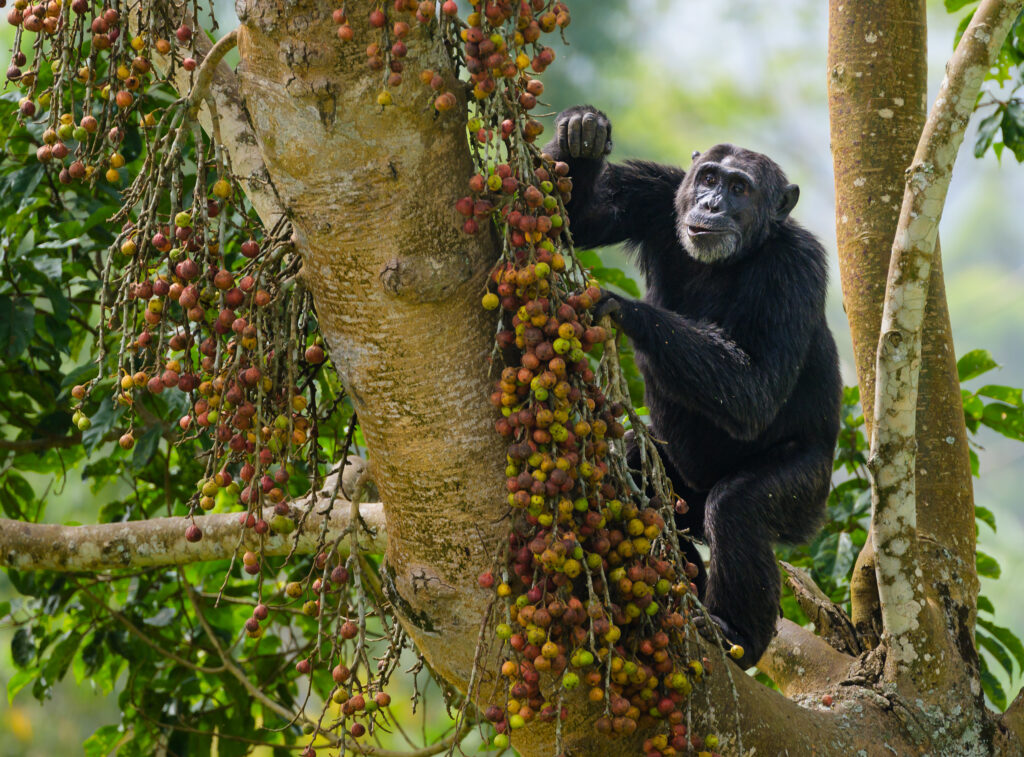
Chimpanzees (Pan troglodytes) are medium-sized great apes with long arms, a stocky build, and expressive faces. Adult males weigh between 90–130 pounds, with females slightly smaller. Their hair is black or dark brown, and their faces range from pale to dark with noticeable individual variation—perfect for portraits.
Their muscular limbs and opposable toes allow them to navigate treetops as easily as the forest floor. When they pause, their posture—knuckle-walking or sitting cross-legged—gives photographers a window into behavior that is strikingly human.
Physical Variations Amongst the Species
There are four subspecies of chimpanzee across Africa, with small differences in facial color, size, and vocal patterns. The Eastern Chimpanzee (Pan troglodytes schweinfurthii), found in Uganda and Tanzania, is the most commonly seen on trekking photo tours. Individuals vary in facial expression, hair texture, and posture—making each chimp uniquely identifiable in your images.
Native Habitat Around the World
Chimpanzees are native to equatorial Africa, living in tropical forests and savanna woodlands across:
- Uganda
- Tanzania
- Democratic Republic of Congo
- Cameroon
- Gabon
- Ivory Coast, and others
They prefer dense forest habitats with ample food, nesting sites, and canopy cover but are also found in forest-savanna mosaics where tree cover is patchy.
Who Preys on the Chimpanzee
Natural predators include leopards, large pythons, and crocodiles, though chimpanzees are highly social and defend one another fiercely. Their biggest threats today are human-driven: poaching, habitat loss, and disease transmission from close human contact.
Food/Eating Habits of the Chimpanzee
Chimpanzees are omnivores with a broad and intelligent diet. They eat fruit, leaves, seeds, insects, and occasionally small mammals—even hunting colobus monkeys in coordinated group strategies.
Their use of tools—sticks for termite fishing, stones for cracking nuts—makes them one of the few non-human species known to use and pass on cultural knowledge. Photographing them during feeding or tool use offers rare, documentary-style moments.
Known Lifespan
In the wild, chimpanzees live 30–40 years, though individuals in protected sanctuaries have reached 50–60 years. Males often dominate social hierarchies from their mid-teens to late 30s, while females raise offspring with deep, visible bonds.
Join Us on a Wildlife Workshop
We trek to photograph wild chimpanzees in Uganda—one of the most rewarding chimpanzee destinations in Africa. These forests are thick, humid, and alive with sound—an unforgettable stage for capturing intimate and powerful images.
We’ll teach you how to photograph fast-moving primates in low-light jungle conditions, anticipate behavior in groups, and use ethical distance to still capture expressive close-ups. From juveniles wrestling in the trees to matriarchs grooming in shafts of golden light—this is storytelling photography at its best.


