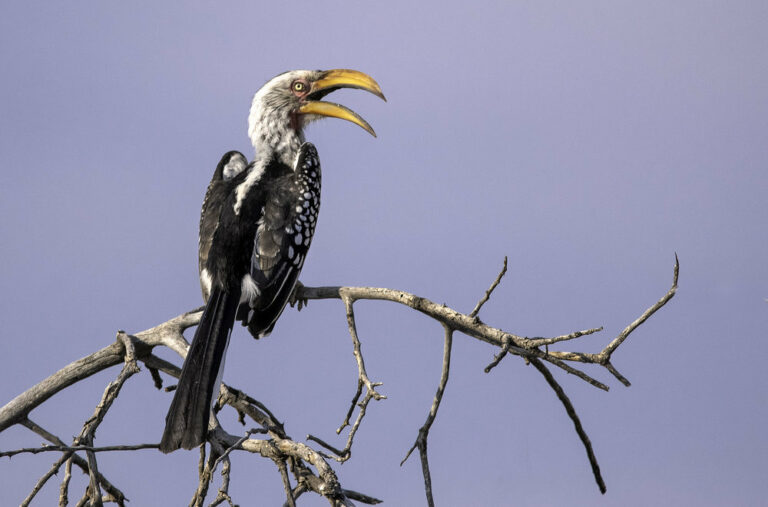
Species Spotlight: Northern Anteater-Chat
By Kevin Pepper |
The Termite Mound Lookout of the African Plains
The Northern Anteater-Chat is one of those birds that looks like it has a job.
You’ll often see it perched upright, alert, and serious—usually on a termite mound, rock, or low rise—watching the world like a tiny supervisor of the savanna.
It’s not flashy. It doesn’t need to be. It has attitude.
Introduction of the Species
The Northern Anteater-Chat (Myrmecocichla aethiops), also called the anteater chat, is an African chat in the flycatcher family (Muscicapidae). Its range stretches across the Sahel and into parts of East Africa, and it uses dry savanna and grassland habitats, including some higher-altitude grasslands.
This is a great species for photographers who enjoy behavior and posture. It often gives you that classic upright “on watch” look that reads beautifully in a frame.
Physical Description
Northern Anteater-Chats are compact, upright chats with a sturdy, ground-oriented feel.
- Build: Stocky, upright posture typical of many chats
- Plumage: Generally brown to gray-brown upperparts with patterned/streaked tones and paler underparts (appearance can vary with age, sex, and light)
- Bill: Fine, pointed insect-eating bill
- Posture: Often seen perched prominently while scanning the ground
They’re not a bird of bright colors—they’re a bird of shape, behavior, and stance. Which, for good wildlife photography, is often even better.
Native Habitat
Northern Anteater-Chats are associated with open, dry habitats, including:
- Dry savanna
- Tropical/subtropical dry lowland grassland
- High-altitude grassland in parts of their range
They are also strongly associated with termite mounds in many field observations, which often serve as hunting perches and lookout points (widely noted by birders and field guides).
For photographers, termite mound perches are a gift:
- natural elevated platform
- cleaner backgrounds
- better eye line
- easy storytelling
Range and Movement Patterns
BirdLife lists species-level migratory status fields for this species, and the species is generally treated as resident across much of its range. The Northern Anteater-Chat is usually encountered as a local, territorial bird rather than a long-distance migrant.
It often stays low to the ground or on short perches, scanning for insects. That repeated perch-and-drop behavior can help photographers anticipate where to frame.
Food / Eating Habits
As the name hints, the Northern Anteater-Chat is closely associated with ants and termites, but it feeds more broadly on insects and other small invertebrates. Field references commonly note items such as termites, ants, beetles, grasshoppers, moths, spiders, and caterpillars.
It typically hunts by:
- watching from a perch (often a termite mound)
- dropping to the ground to grab prey
- returning to a lookout point
That makes it a fun species for behavior photography—especially when you catch the launch or return.
Known Lifespan
Specific lifespan figures for Northern Anteater-Chat are not widely published in general birding sources. Like many small insectivorous passerines, survival is influenced heavily by habitat quality, predation, and seasonal food availability.
If you want, I can do a follow-up version with a more technical “what we know / what we don’t know” section for the species.
Why Photographers Love the Northern Anteater-Chat
This is a photographer’s “fieldcraft bird.”
It offers:
- excellent posture
- reliable perches
- classic savanna context (especially termite mounds)
- behavior you can anticipate
- strong environmental compositions
It’s also the kind of species that rewards patience. Spend a few extra minutes with one, and you often get better images than you expected.
Join Us on an African Safari and Photograph a Northern Anteater-Chat
If you want your safari portfolio to feel complete—not just big mammals, but the real rhythm of the ecosystem—the Northern Anteater-Chat is exactly the kind of species worth photographing.
At Akari Photo Tours, we help photographers slow down, read behavior, and make images with intention. That applies just as much to a chat on a termite mound as it does to a lion on the move.
Join one of our African photo safaris and come photograph the birds and behaviors that make the African plains come alive.