Trip Report For our 2026 Namibia Photo Workshop
By Kevin Pepper |
As I write this, I’m somewhere over the Atlantic, watching the flight map slowly creep toward Frankfurt. For most people, getting to Namibia Photo Workshop is a simple one-stop journey. For me, it’s two long flights. Thankfully, a comfortable seat, plenty of legroom, and onboard Wi-Fi make the hours pass surprisingly quickly. It’s the perfect opportunity to catch up on work, look over the itinerary a few more times, and get excited for what lies ahead.
Over the next 13 days, our group will photograph many of the places that have made Namibia one of my favourite destinations on the planet. We’ll search for wildlife in Etosha and Ongava, stand beneath the towering granite peaks of Spitzkoppe, spend time with the Himba people, chase the changing light across the dunes of Sandwich Harbour, photograph Sossusvlei and Deadvlei from both the ground and the air, wander the haunting ruins of Kolmanskop, stop at the legendary Solitaire, and finish beneath the ancient quiver trees. That’s a pretty impressive lineup for one workshop… and somehow Namibia always finds a way to add a few surprises.
I’ve been leading photography workshops here since 2013, and no two trips have ever been the same. The dunes shift with the wind, the light paints a different story every morning and evening, wildlife has a habit of rewriting the schedule, and every group brings its own personality. That’s one of the reasons I keep coming back. Just when I think I know what Namibia is going to give us, Mother Nature decides to do something completely different.
This year’s Namibia Photo Workshop is another full one, with five photographers ready for the adventure. Joining me is my brother from another mother, Mr. T, whose knowledge of Namibia seems to have come pre-installed at birth. Between the two of us, we’ll be chasing great light, unforgettable wildlife encounters, and hopefully a few photographs that make everyone at home wonder why they didn’t come with us. If history is any guide, there will also be plenty of laughs, a few early mornings that nobody enjoys until the coffee kicks in, and more than one moment where we all stand in silence simply taking in the incredible landscapes around us. (Spoiler Alert: this year it was the doors off heli flights)
Namibia, we’re headed your way! Let’s see what you’ve got for us this year.

Day One In Windhoek
Day one of our Namibia workshops is usually pretty simple: everyone arrives, settles into the hotel, and we meet later for our welcome dinner and trip briefing.
This year, however, everyone arrived early. And rather than spend the afternoon sitting around the hotel trying to convince ourselves we weren’t tired from the flights, we decided to head into Windhoek for an impromptu city tour.
Our first stop was a museum, where we spent some time learning about Namibia’s history. Photography may be the reason we are here, but I have always believed that understanding a little about the history, people and culture of a country makes the experience—and the photographs—we create along the way more meaningful.
From there, we took care of some less glamorous but equally important travel business. We stopped at the MTC store so anyone who wanted one could pick up a local SIM card, exchanged some money and bought a few supplies for the road ahead. Not exactly National Geographic material, but every great African adventure apparently begins with mobile data and a trip to the store.
We also visited Christuskirche (Christ Church), Windhoek’s distinctive Lutheran church dating back to 1910, before making our way through one of the local markets. It was a nice introduction to the city and our first chance to wander around with cameras while getting a feel for daily life in Namibia.
We finished the evening with our official workshop briefing followed by dinner at Joe’s Beerhouse.
Trying to describe Joe’s Beerhouse to someone who has never been there is difficult. Imagine an African safari lodge, a German beer hall, an antique shop and somebody’s garage all having a meeting and deciding to open a restaurant together. Memorabilia is hanging everywhere, cold beer starts arriving at the tables, and there is enough meat on the menu to make a vegetarian quietly reconsider their life choices.
It is quirky, loud, completely unapologetic and one of those Windhoek institutions that everyone should experience at least once.
By the time dinner was finished, introductions had been made, stories were already being exchanged, and the group was settling in.
Tomorrow, the wildlife portion of the workshop begins.

Etosha National Park and Ongava
Setting the tone for our road days, today was the first of our healthy drives. We departed early and drove north to Ongava, where we will be having our first game drive for 3.5 hours before sunset.
Watching the smile on people’s faces as they return from their rooms after lunch at Anderssons Camp is half the fun for me here in Ongava. It’s a fantastic oasis with a small watering hole right near where we eat, and the tents are decadent, spacious and have expansive views of the open plain area. You can read about them here.
One of the most important skills in leading a photography workshop is knowing when to abandon the plan you started with. Wildlife doesn’t read itineraries, and neither do the best photographic opportunities. My job is to read the situation, adapt quickly, and make decisions that give the group the strongest possible chance of success in the field.
This trip was a perfect example.
On our first night drive at Ongava, we had one of those encounters that reminds you why you come to Africa. We found two lionesses with four cubs and spent time with them without another vehicle in sight.
The cubs were doing what cubs do—playing, exploring and generally ignoring any concept of personal space—while the mothers kept watch. We had room to move our vehicle, think about backgrounds, anticipate behaviour and photograph the scene without competing with a line of safari vehicles.
That evening at dinner, the conversation turned to our plans for Etosha.
I gave the group my assessment. Etosha is one of Namibia’s best-known safari destinations, but from a photography standpoint it comes with compromises. Popular waterholes can become crowded with vehicles, wildlife can be spread over enormous distances, and you cannot enter the park until sunrise.
That works perfectly well for many safari travellers. But photographers tend to be a little more demanding. We want the lion in the first light, not to be sitting at the gate when the first light is happening.
The group asked me what I thought we should do.
“Stay at Ongava.”
The next morning, as if the wildlife had been listening to our dinner conversation, we drove about five minutes from camp and found three white rhinos.
Decision validated.
With nobody forcing us to move along, we spent time positioning ourselves for the light and waiting for the rhinos to move into the right places. For the next hour, we photographed them from the vehicle and came away with some fantastic images.
Then we changed perspective completely.
With our guide, we left the vehicle and carefully approached on foot, eventually photographing the rhinos from roughly 60 metres away. Standing on the ground photographing a white rhino is a very different experience from looking at one through the window of a safari vehicle. You become considerably more aware of just how large a rhino actually is.
At one point, one of our guests looked at the time and said, “Right about now we would have been sitting in line waiting to get into Etosha.”
Exactly.
For two days, it felt like we had our own private safari.
We would occasionally spot another vehicle in the distance, but rather than competing for sightings, the guides communicated with each other and shared what they were finding. Everyone had the opportunity to enjoy what Ongava was offering without a crowd gathering around every animal.
And Ongava gave us plenty.
Our species highlights included African elephants, lions, white rhinos, black rhinos and giraffes. Add in the many antelope species and bird life we encountered, and there was rarely a shortage of something to photograph.
Seeing both black and white rhinos was particularly special. They are two very different animals to photograph, and having opportunities with both during such a short stay was another reminder of just how productive a private reserve like Ongava can be.
After more than ten years of bringing photographers to Namibia, experiences like this have shaped how I prefer to photograph wildlife here. Smaller private reserves give us something that is increasingly valuable: fewer vehicles, excellent wildlife density, flexibility and the ability to make decisions based on photography rather than a rigid schedule.
Add excellent lodging and great food at the end of the day, and it becomes an easy decision for us.
There are less expensive ways to run a Namibia photography workshop, including using the government-operated camps inside Etosha. Some companies do exactly that. We choose a different approach. We would rather stay somewhere that improves both the photographic opportunities and the experience between them.
It was a pretty perfect way to begin our 2026 Namibia Photography Workshop—and we were only two days in.
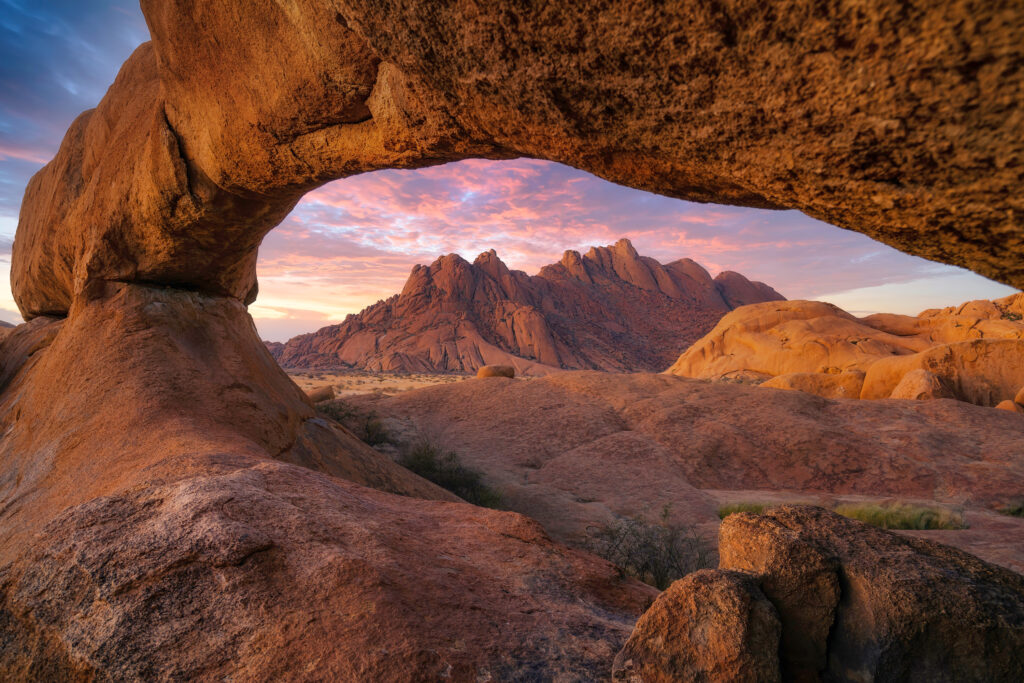
Spitzkoppe Night Skies
Nothing like getting taken to your room on a golf cart… it always makes me smile as the golf cart follows the twisting paths to everyone’s rooms. After a long day driving and spending time with the Himba today, we got to Spitzkoppe and got the guests settled in before the photography started. Spitzkoppe offers several levels of accommodation, from basic campsites and simple cabins to more comfortable lodges and luxury chalets. We chose the luxury chalets because they give our guests a quiet, comfortable place to rest after long days of photography and late nights beneath the stars. The added space, private facilities and better amenities make a real difference in the desert, allowing everyone to recharge properly without taking away from the remote experience that makes Spitzkoppe so special.
We arrived at Spitzkoppe with one very specific photographic goal: the Milky Way rising over the famous rock arch.
That was the plan, anyway.
Mother Nature had other ideas.
Fog rolled in from the coast and slowly covered about 25% of the sky. It wasn’t enough to ruin the night completely, but it was enough to interfere with the composition we had come here to photograph.
This is where knowing a location well becomes important. After years of bringing groups to Spitzkoppe, I’ve learned that you always need another option. Sometimes you need two.
Plan B was simple: get some sleep and reset for an early sunrise.
Not everyone was quite ready for bed, though. A few of the group headed into a nearby valley where the fog had almost no visual impact. From there, they were able to photograph a vertical Milky Way appearing to rise straight out of the mountains. It wasn’t the image we originally came for, but it turned into a completely different opportunity.
For the rest of us, the alarm clocks came early.
We were up before sunrise and positioned to photograph the first light appearing over the distant mountains. As the sun climbed higher, we turned our attention west, where the morning light began to transform the granite landscape of Spitzkoppe.
The stone shifted through shades of orange and pink as the light moved across the mountains. It was one of those mornings that reminded us why being flexible matters so much in landscape photography.
You can plan the location. You can study the Milky Way. You can know exactly where you want to stand.
Apparently nobody sent Mother Nature the itinerary.
After sunrise, we headed back for a hearty breakfast before packing up and making the dash toward Walvis Bay. There was just enough time for a quick rest before the next photographic opportunity.
By late afternoon, we would be heading into the dunes high above the Atlantic Ocean for our sunset shoot.
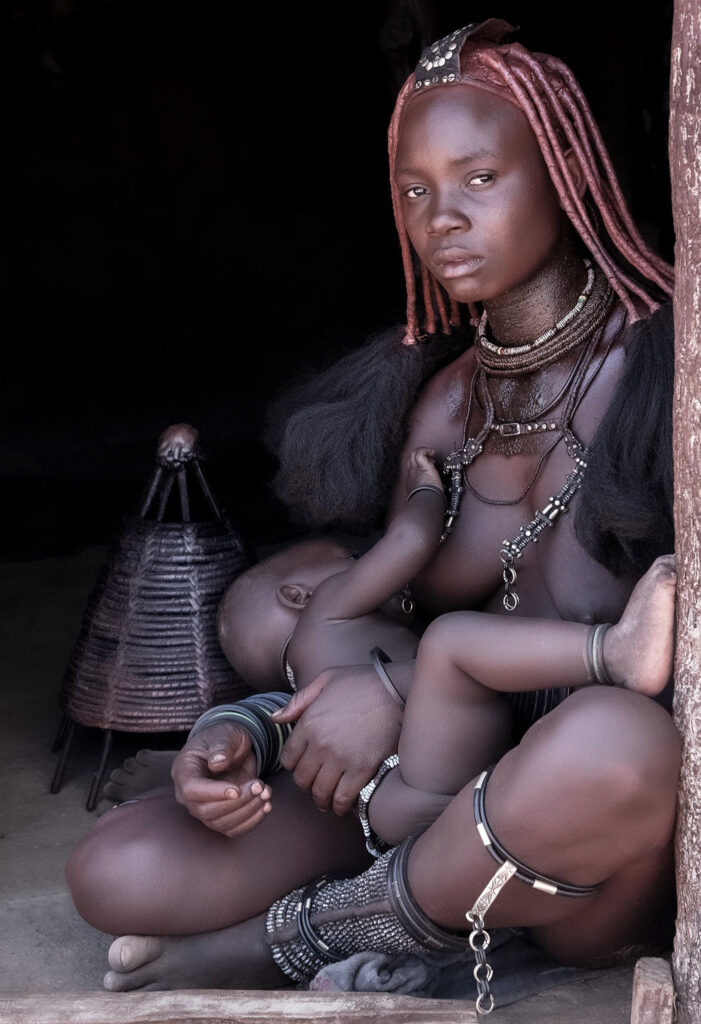
Meeting the Himba Tribe – “Moro, Perevee, Nawa”
After an exciting few days of wildlife photography at Ongava, it was time to switch gears.
We left the lions, rhinos and elephants behind and headed north to spend time with the Himba, one of Namibia’s most recognizable Indigenous cultures.
Before we picked up our cameras, our visit began with a history lesson. I think that part matters. If we are going to photograph people and their traditions, I want the group to understand something about who they are, how they live and the customs we are being invited to witness. The photographs mean more when you understand the story behind them.
When we arrived at the village, we didn’t immediately start taking photos. We spent some time talking, laughing and getting comfortable with one another. Cameras eventually came out, but only after everyone had a chance to settle in. Before long, our group was dancing, mingling and making new friends.
While that was happening, I began taking the photographers into one of the huts, one at a time, for something very different: photographing a traditional Himba smoke bath.
Water has historically been scarce in the arid regions where many Himba live, so bathing traditions developed differently. During a smoke bath, aromatic herbs and wood are burned in a small container and the smoke is allowed to surround the body. The warm, fragrant smoke is traditionally used as part of personal cleansing and grooming, often alongside the ochre-and-butterfat mixture known as otjize that is so closely associated with Himba culture.
Photographically, it was a fantastic situation.
Inside the hut we worked with a combination of constant lighting and the natural light coming through the doorway. One photographer at a time had the opportunity to work with the Himba woman as she went through the smoke-bath process.
There was no assembly line and no pressure to make the same photograph as the person before them. Each photographer could interpret the scene differently. Some concentrated on the smoke and atmosphere. Others worked with the light on her face, the details of her hair and jewellery, or the relationship between the darkness of the hut and the light entering through the doorway.
My role was simply to help when needed—adjust the light, suggest a position, talk through exposure or composition, and then get out of the way.
The sessions felt effortless. Behind the scenes I snapped a few photographs of each photographer working, but this wasn’t about me building my own portfolio. The focus was on the Himba woman and the photographer in front of her, giving each person the time and space to create something that felt like their own photograph.
After everyone had finished, we came back together for a catered lunch at the village. Then the dancing started again, giving us one final opportunity to photograph, participate and enjoy the time we had with our hosts.
It was a very different day from the wildlife photography we had been doing at Ongava, and that was exactly the point. Namibia gives you the opportunity to completely change photographic gears in a matter of hours.
With our memory cards a little fuller—and perhaps a few questionable dance moves documented for future blackmail—it was time to say goodbye and continue south.
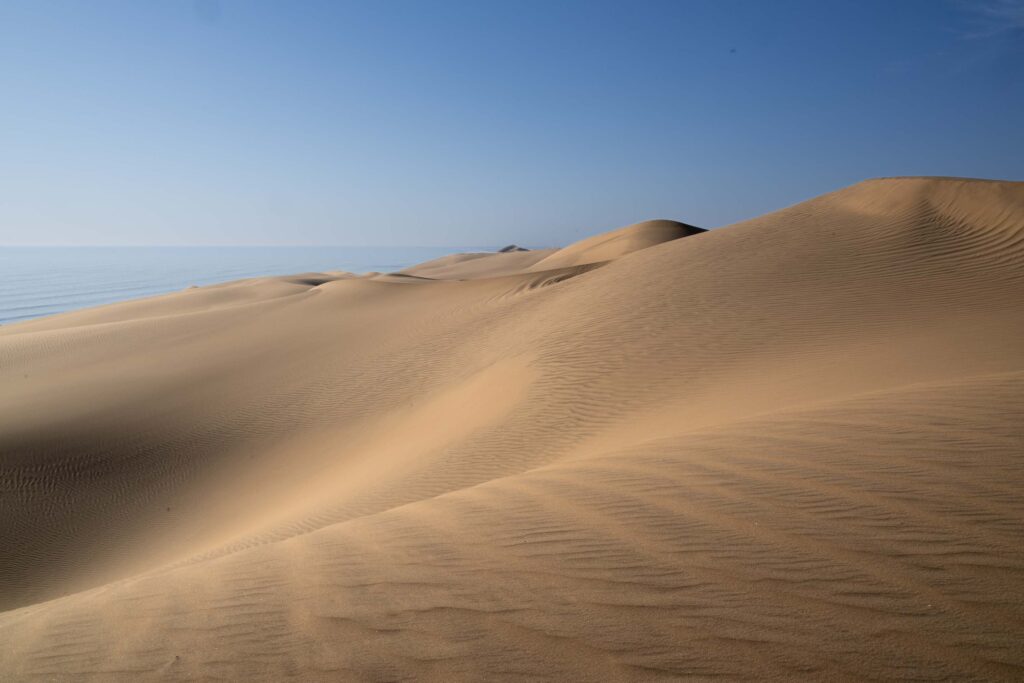
Sandwich Harbour: Where the Desert Wins… Until the Tide Comes In
If you’ve never been to Sandwich Harbour, let me paint the picture.
Imagine the world’s biggest sandbox deciding it wants beachfront property.
This is one of the few places on Earth where massive sand dunes march straight into the Atlantic Ocean. It’s a landscape that looks completely made up until you’re standing on top of a dune, wondering how something this beautiful can actually exist. One direction is nothing but endless desert. The other is the crashing Atlantic. Somewhere in the middle, photographers are trying to decide which way to point their camera first.
Getting there is half the fun.
Our local drivers seem to have an unwritten agreement not to mention just how steep the dunes are until you’re already climbing one. They attack the sand with confidence while the rest of us alternate between laughing and holding onto the grab handles. Then you reach the top, look out over the ocean meeting the dunes, and immediately forget the mini heart attack you had thirty seconds earlier.
The late afternoon light was spectacular. Every ridge in the dunes cast long shadows, bringing out textures that changed by the minute. The ocean reflected deep blues while the sand glowed shades of gold and orange. Every few hundred metres another composition appeared, followed quickly by someone saying, “Can we stop again?” It’s a phrase our drivers hear a lot. Fortunately, they’re patient. They know photographers suffer from a condition known as Just One More Photo Syndrome.
As the sun dropped lower, we found the perfect spot to enjoy a traditional Namibian sundowner. Drinks came out, cameras finally went away… for almost five minutes… and everyone simply took in the view. The cool Atlantic breeze balanced the warmth of the desert, and the landscape slowly shifted from gold to orange to soft pink before fading into blue.
These are the moments that are difficult to explain to someone who hasn’t experienced them.
Yes, the photographs are incredible.
But what stays with you is standing on a giant dune, surrounded by new friends, laughing about the roller-coaster ride that got you there, watching one of Africa’s most extraordinary sunsets unfold in complete silence.
Well… complete silence until someone spotted better light fifty metres away and the cameras came back out.
Photography Lessons from our Namibia Photo Workshop at Sandwich Harbour
During our afternoon in the dunes, we focused on several techniques that helped everyone come home with stronger landscape images:
Learning when to shoot wide to tell the story—and when to zoom in on the abstract patterns carved by wind and light.
Balancing exposure between the bright sand and the darker Atlantic Ocean.
Using the sweeping dune ridges as natural leading lines through the composition.
Including vehicles or people to show the incredible scale of the landscape.
Using the low-angle golden-hour light to emphasize texture, curves, and shadow.
Looking for compositions that showcased the dramatic meeting of desert and sea.

Solitaire Apple Crumble
Solitaire is one of those places that makes perfect sense only after you have been there.
Sitting along a lonely stretch of road in the Namib Desert, it looks like someone gathered an old fuel station, a bakery, a collection of rusting cars, a few cactus plants, some dusty signs and several decades of desert history, then decided that was plenty. It is part roadside stop, part open-air museum and part proof that nothing in Namibia is ever quite ordinary.
Namibia photo workshop groups like us usually arrive hungry, slightly dusty and more than ready for lunch. The food is simple, filling and exactly what you need after a morning on the road. Sandwiches, hot meals, cold drinks and coffee all do their job, but everyone knows the real reason photographers stop at Solitaire.
The apple crumble.
It has become almost as famous as the sand dunes. Warm, sweet, heavy enough to count as a meal and usually served in a portion that suggests moderation has no place in the desert. People begin by saying they will share one. That plan normally lasts about thirty seconds.
While lunch settles in, there is plenty to photograph. Old cars sit half-buried in the sand, faded signs lean at odd angles, and bits of machinery appear to have been left exactly where they stopped working. It is eclectic, weathered and wonderfully strange. Solitaire is not polished, and that is its charm. It feels like a place the desert has slowly claimed, while still allowing the bakery to remain open.
By the time we left this year, everyone was full, the cameras had been used, and at least one person ( I won’t say who) was quietly wondering whether there was time to buy another piece of apple crumble for the road.

Sossusvlei and Deadvlei
Deadvlei is one of the true highlights of this workshop, and you could feel the anticipation in the group long before we arrived.
We left as soon as the park gates opened. From there, it is roughly a 45-minute drive followed by about a three-quarter-mile walk through the dunes to reach Deadvlei.
We arrived in the dark, which is exactly how we like it.
Getting there early gives us enough time to walk the group through some of our favourite compositions before the light begins to change. After years of photographing Deadvlei, we know where the light will fall and when certain compositions are at their best. That preparation means our guests are not scrambling around trying to figure things out while the best light disappears.
We spent nearly three hours photographing, beginning in blue hour and continuing until the entire clay pan was lit by the morning sun.
As the light changed, so did the photographs.
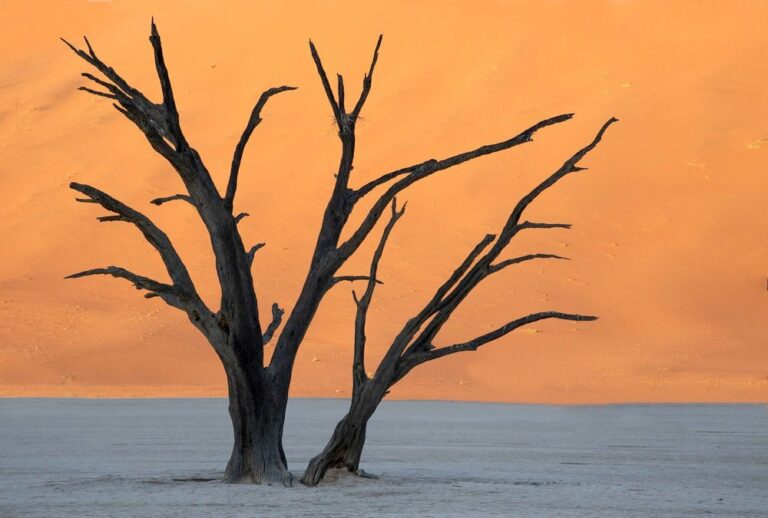
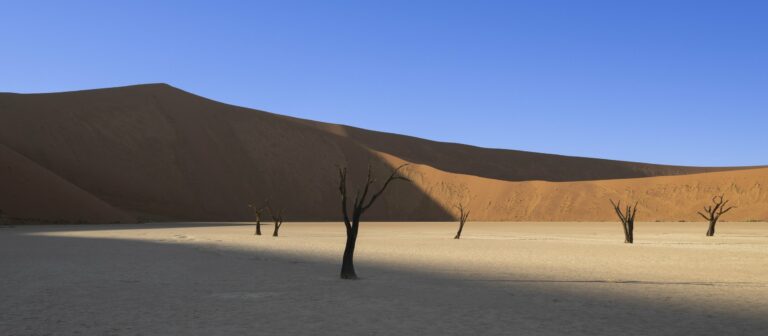
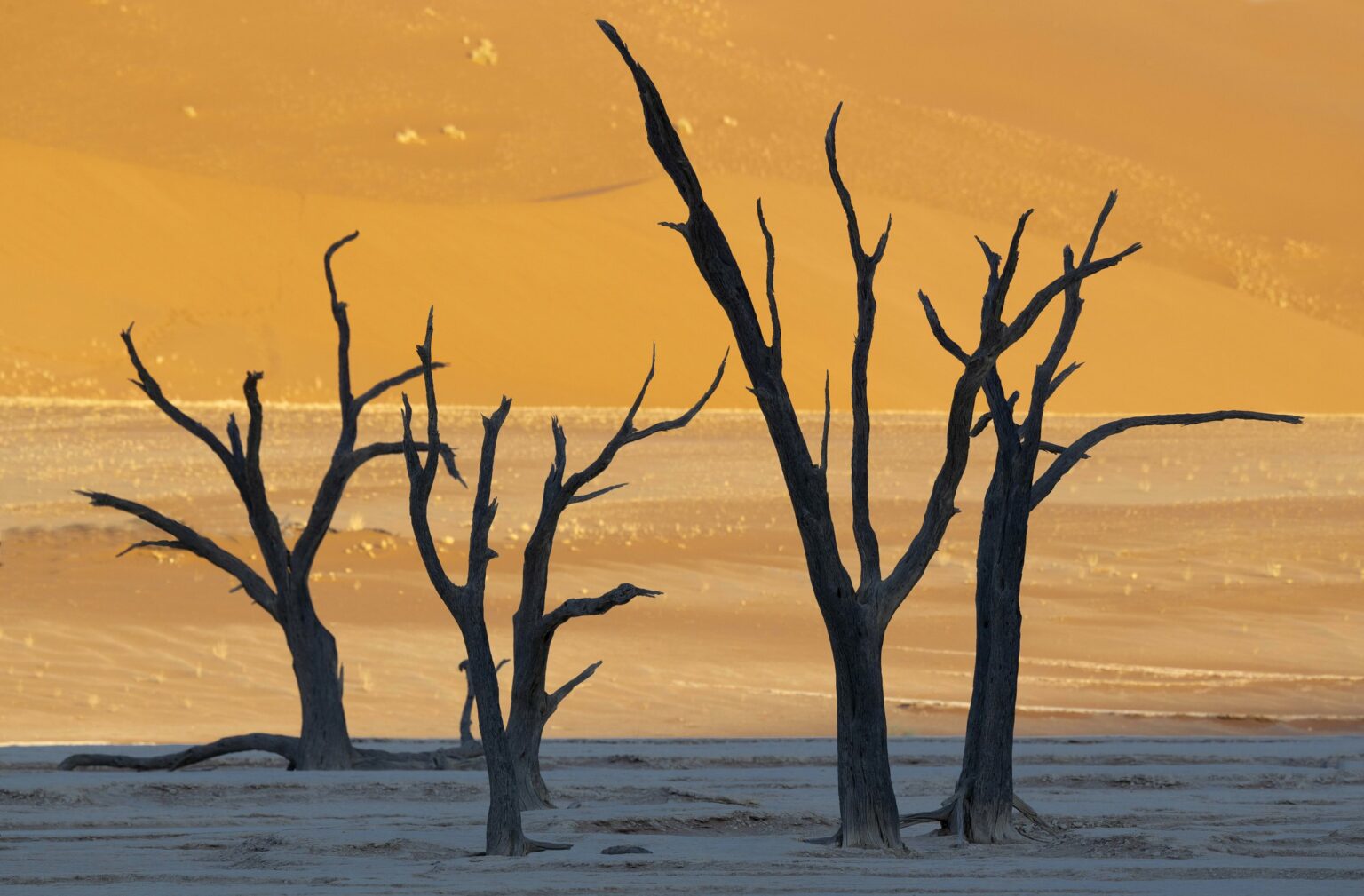
The dead camel thorn trees slowly separated from the darkness. The red dunes began to glow. Shadows shifted across the white clay pan, creating those graphic compositions that make Deadvlei so recognizable.
A few people said it was even better than they had expected.
I think a few others were simply speechless.
For some, this was a place they had wanted to photograph for decades. There is something different about finally standing in a landscape you have seen in photographs for most of your life and realizing that this time, you are the one behind the camera.
Eventually, hunger won and we made our way back to Sossusvlei for breakfast.
Our time in the dunes was far from finished, though.
We returned to the corridor several times during our stay, and each visit offered something different. Different light, different shadows and different compositions.
Between sessions we talked about what worked, what could be improved and how changing camera position, focal length or exposure could completely alter the photograph. Then we went back out and tried again.
That repetition is one of the best ways to learn. Photograph it, review it, talk about it and then return with a better idea of what you want to accomplish.
Of course, returning to the dunes also gave us another perfectly reasonable excuse for a sundowner in one of the most surreal landscapes in Namibia.
We also took our photography into the air with two separate doors-off helicopter flights timed for golden hour. From above, Namibia becomes an entirely different place. The dunes turn into patterns of light and shadow, dry riverbeds become leading lines, and wildlife that can disappear into the landscape from ground level suddenly becomes part of a much larger story. Flying with the doors off gives you an unobstructed view and the freedom to compose as the landscape changes beneath you. By splitting the group between two flights, everyone had a front-row seat with a clear view to photograph some of the finest desert scenery in the world in the best light of the day.
When our time around Sossusvlei finally came to an end, it was time to switch photographic gears once again.
We headed south toward Kolmanskop.
The sweeping desert landscapes were about to be replaced by abandoned rooms, peeling walls, shafts of light and buildings slowly being swallowed by sand.
And with that came a completely different lesson: how to use light, shadow, depth and composition to make a two-dimensional photograph feel three-dimensional.
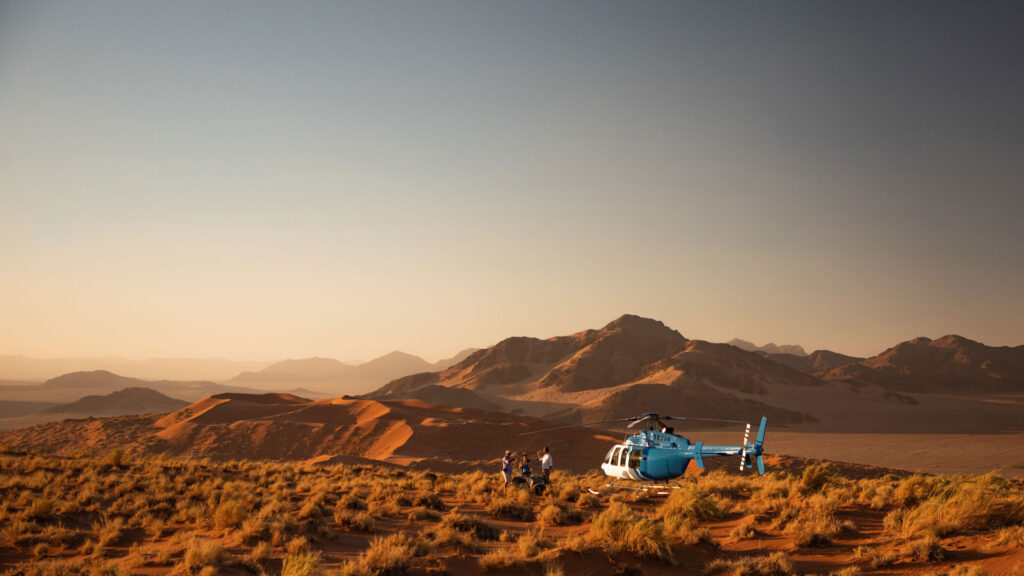
Doors Off Heli Flight
There are some photography experiences that are exciting before you even take the first frame.
Our doors-off helicopter flights over the Namib Desert were definitely one of them.
We scheduled two separate flights so that everyone had a window seat, an unobstructed view, and the chance to photograph without someone leaning across them every time the landscape opened up below.
And we timed both flights for sunset.
As we lifted off, the dunes around Sossusvlei began to change colour. The low sun carved deep shadows into the ridgelines, while the sand shifted through shades of gold, orange and red. From the air, familiar landscapes suddenly looked completely different. Patterns appeared that you simply cannot see from the ground, and every turn of the helicopter revealed another composition.
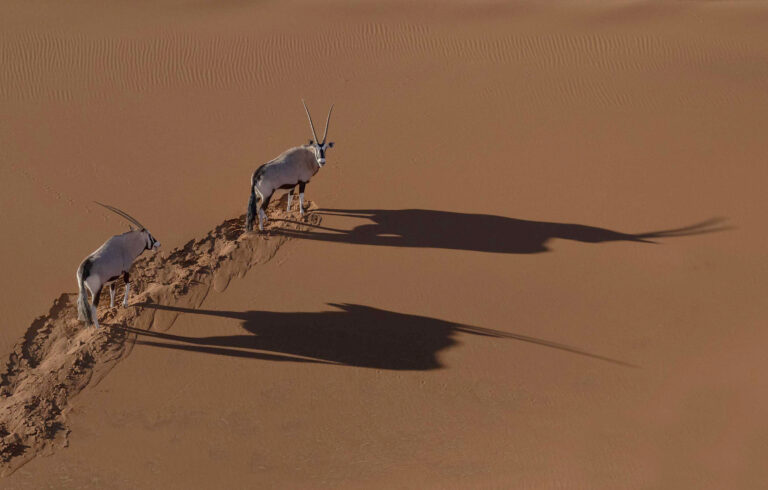
Then came the oryx.
Seeing oryx walking through the dunes is impressive from ground level. Seeing them from the air, surrounded by vast curves of untouched sand, is something else entirely. Their long shadows stretched across the dunes while the late-day light created the kind of scenes that make you forget, for a moment, that you are hanging out of the side of a helicopter with no door beside you.
Almost.
The doors-off experience adds another level of excitement. There is nothing between you and the landscape except your camera, the wind and a very healthy respect for the seatbelt.
The light could not have been better.
As the sun continued to drop, we photographed the enormous dune systems around Sossusvlei from perspectives that are impossible to experience any other way. The combination of wildlife, sweeping desert patterns and spectacular golden-hour light made these flights one of the clear highlights of the trip.
By the time we landed, everyone was smiling.
Some experiences produce great photographs.
Others remind you why you fell in love with photography and travel in the first place.
This one did both.
Kolmanskop
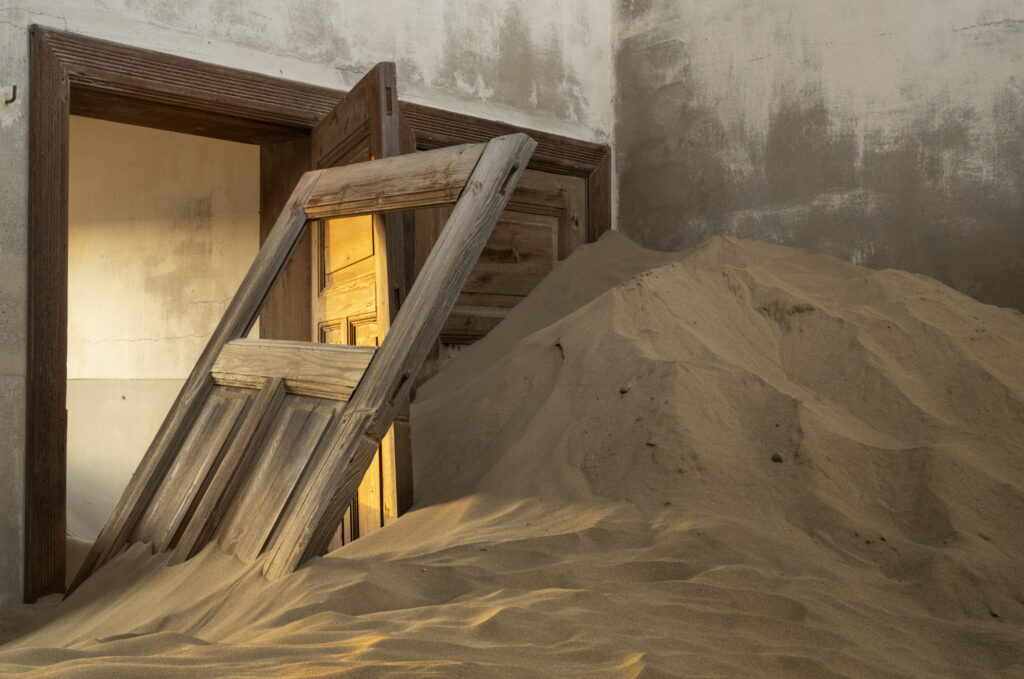
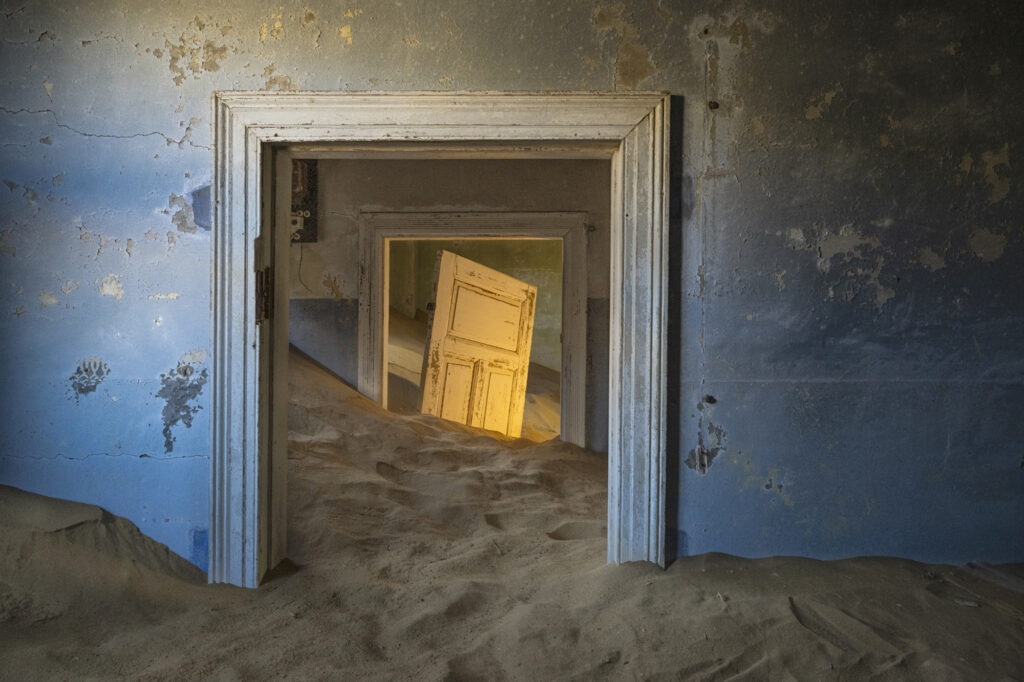
Kolmanskop is one of the most interesting places to photograph in Namibia. Just outside Lüderitz, this abandoned diamond-mining town is slowly being reclaimed by the desert, with sand pouring through doorways, faded wallpaper peeling from walls and empty rooms shaped by decades of wind and light. What makes it so compelling is the contrast between the old European architecture and the Namib Desert moving through it one room at a time. There are wide architectural scenes, intimate details, patterns, textures, shadows and minimalist compositions everywhere you look. The obvious photograph is the classic sand-filled room, but the stronger challenge is to show the relationship between the buildings, the desert and the passage of time.
After returning to Kolmanskop many times on our Namibia photography workshops over the last decade, I have learned that timing matters as much as composition. On this workshop, the morning light seemed to move quickly from room to room, and each space had a short window when it is at its best. One room glowed just after sunrise while another came alive later as a beam of light moved across the sand. That is why early access and knowing where to go first makes such a difference. We planned our time around the direction of the light, moving through the buildings as conditions change. The goal was not simply to find sunlight, but to watch how it shapes the room—how shadows create depth, how side light reveals texture and how reflected light softens a scene. Sometimes the best photograph was there immediately. More often, it appeared when you waited a few minutes and let the light do the work.
As a photography instructor, there are always a few thoughts sitting in the back of your mind.
Will the wildlife cooperate? Will golden hour actually deliver? What is Plan B if the weather decides to ignore the itinerary?
At Kolmanskop, I really only have one concern:
Will the espresso machine in the café be working?
After more than ten visits to this abandoned diamond-mining town, the routine doesn’t change much if you know the location well. Certain rooms photograph better at certain times of day. The angle of the sun matters. The direction of the light matters. And, perhaps most importantly, the number of photographers trying to squeeze into the same room matters.
With a group of five guests, everyone had the opportunity to work our favourite rooms when the light was at its best.
No rushing. No fighting for tripod space. No eight photographers and a couple of instructors trying to create the exact same photograph from the same doorway.
We photographed Kolmanskop at sunrise and again during the final light of the day, timing our movements through the buildings so everyone could work the strongest compositions when the light was doing exactly what we wanted it to do.
We also purchase entry permits across multiple days for a reason. Between sessions, we review images together and talk about what everyone is seeing. We look at leading lines, colour, depth, shadows and how the sunlight moves through the rooms and paints the interior walls.
Then we go back and do it again.
That second opportunity is often where things really start to come together. Instead of simply reacting to the scene, everyone returns knowing what they want to improve and what they want to photograph differently.
This year, two sessions were enough.
We had originally planned for a third, but after reviewing the images, there simply wasn’t a reason to force another visit. Everyone had what they wanted.
So we did something almost unheard of on a photography workshop.
We slept in.
At least a little.
Then it was time to point the vehicles east toward the Quiver Tree Forest.
But this is Namibia, and apparently no 600-kilometre driving day is complete without a strategic food stop.
So before the quiver trees, there was German chocolate cake and pie in Aus.
Photography requires sacrifice.

Quiver Tree Forest
The Quiver Tree Forest was our next stop, and as we do every year, we arrived with our eyes on the night sky.
Quiver trees are not actually trees at all, but a species of aloe that can survive in the harsh, dry conditions of southern Namibia. Their thick trunks and branches store water, and their distinctive shapes make them one of the most recognizable plants in the Namibian landscape. The name comes from the San people, who traditionally hollowed out the tubular branches to make quivers for their arrows.
For photographers, they are even better after dark.
Our plan was to photograph the trees silhouetted beneath a sky full of stars, with the Milky Way rising behind them.
Mother Nature, however, had been reading our itinerary again.
Clouds began moving in, so instead of waiting around hoping they would disappear, we concentrated on making the most of sunset. As the sun dropped lower, the quiver trees began to glow gold while patches of colour developed in the sky behind them. We moved through the forest looking for different shapes, silhouettes and compositions as the light changed.
And, to be fair, sunset put on a pretty good show.
Still, we weren’t quite ready to give up on the stars.
At 1:00 a.m., we climbed out of bed and went outside for another look.
The clouds were still there.
Staring back at us.
Apparently they had also decided to spend the night.
That is landscape photography. You can plan the moon phase, study the Milky Way, choose your compositions and set an alarm for an hour when sensible people are sleeping.
But you cannot schedule a clear sky.
We didn’t get the night photography we had hoped for this year, but we did get a beautiful sunset among one of Namibia’s most unusual landscapes—and sometimes the photograph you come home with isn’t the one you originally went looking for.

Every Great Workshop Needs a Mr. T
People often ask what makes our Namibia photo workshops run so smoothly.
The answer isn’t just the itinerary, the lodges, or the incredible locations. It’s the people behind the scenes, and for us, that starts with Mr. T.
Every evening we sit down together and talk through the next day’s plan. We look at sunrise, driving times, weather, meals, wildlife opportunities, and the photography goals for each location. We plan the day carefully… and then intentionally leave room for the unexpected. Namibia has a funny way of rewarding flexibility. Some of our best photographs have happened because we were willing to pull over, change the plan, or spend an extra thirty minutes with great light.
What always impresses me is that while everyone else is finishing breakfast or chatting outside the lodge, Mr. T is already loading luggage into the trailer. Before anyone even thinks about carrying a bag, he’s halfway finished. It’s one of those little things our guests appreciate, even if they don’t always notice it happening.
Then there are the drives.
Somehow, a four-hour drive across Namibia never feels like four hours. Mr. T is talking about the country’s history; next, you’re talking about wildlife; then someone starts singing, another person joins in, and before long the vehicle sounds like a travelling karaoke show with questionable talent. Thankfully, the scenery is spectacular enough to distract everyone from our singing.
The reason I enjoy working with Mr. T so much is that he understands photographers.
If I’m helping someone master back-button focus or explaining why moving three feet to the left completely changes a composition, he doesn’t stand around waiting. He’s already helping someone else, pointing out wildlife, answering questions, or making sure nobody gets left behind. He understands that photography workshops differ from sightseeing tours and knows exactly how to support our guests.
Perhaps the biggest gift he gives me is something most people never see.
I don’t worry about logistics.
The routes are planned. The timing works. The permits are organized. The fuel stops are thought through. The hotels know we’re coming. Meals happen when they’re supposed to happen. Everything quietly falls into place.
That means I get to spend my time where it belongs—with our photographers.
After more than a decade of leading workshops in Namibia, I’ve learned that the right local guide doesn’t just get you from Point A to Point B. They elevate the entire experience. They know the country, they know the people, they know the rhythm of travel… and in Mr. T’s case, they even understand why five photographers will suddenly stop everything to photograph one interesting-looking tree.
Actually… in Namibia, that’s usually a pretty spectacular tree in an ethereal landscape.

Final Thoughts on our 2026 Namibia Photo Workshop
Being back in Namibia reminded me of something I have come to believe more strongly with every workshop: group size matters far more than the instructor-to-guest ratio.
Eight to ten guests with two instructors may sound generous on paper. But once you are standing inside the small rooms of Kolmanskop, watching the morning light pour through broken windows and across the sand-covered floors, the guest numbers begin to tell a different story. There is only so much room to move, compose and wait for the light. Ten photographers sharing that space would completely change the experience.
As a business owner, I understand the temptation to add more guests and improve the financial side of a workshop. But standing in these locations always brings me back to why we do this. Our clients have travelled a long way to photograph places they may only visit once in their lives. They deserve the room, access and personal attention to experience them properly.
Small groups may not produce the best margins on a spreadsheet, but they produce a better workshop. Over time, that is what builds trust and keeps people travelling with us.
At the end of every Namibia Photo Workshop, Mr. T and I sit down and talk honestly about the trip. We review what worked, what could be improved and what we should change before returning the following year.
This time, the conversation began beside the pool after everyone had returned to their rooms and washed away the dust from another day on Namibia’s roads. Before long, our guests joined us with drinks in hand, and the discussion naturally turned to the accommodations, meals and overall experience.
Namibia can be travelled in many ways. You can camp, stay in simple guesthouses or choose comfortable lodges in remarkable locations. Our guests told us how much they appreciated the time Mr. T and I had spent months earlier selecting the places where we would stay and the meals we would share.
That meant a lot to hear because those decisions are never accidental.
After a long day in the desert, a comfortable bed matters. A good meal matters. Having a quiet place to recharge matters. When the alarm is set before sunrise, and the cameras are still working after dark, rest becomes part of the photography experience.
Our Namibia Photo Workshop will not fit every budget, and it is certainly possible to travel through the country for less. But this is a journey many people have dreamed about for years. Our goal has never been to make it as cheap as possible.
Our goal is to make sure that, when the workshop is over, it felt worth it.
Join us on a Namibia Photo Workshop
We offer two different flavors of workshops in Namibia. There is this workshop that offers you the highlights… wildlife, landscapes, dunes and Kolmanskop. We also have a workshop focused on landscapes and night skies under a new moon. You can find our Namibia Photo Workshops here.