Learn about the Pallas’s Cat
By Kevin Pepper |
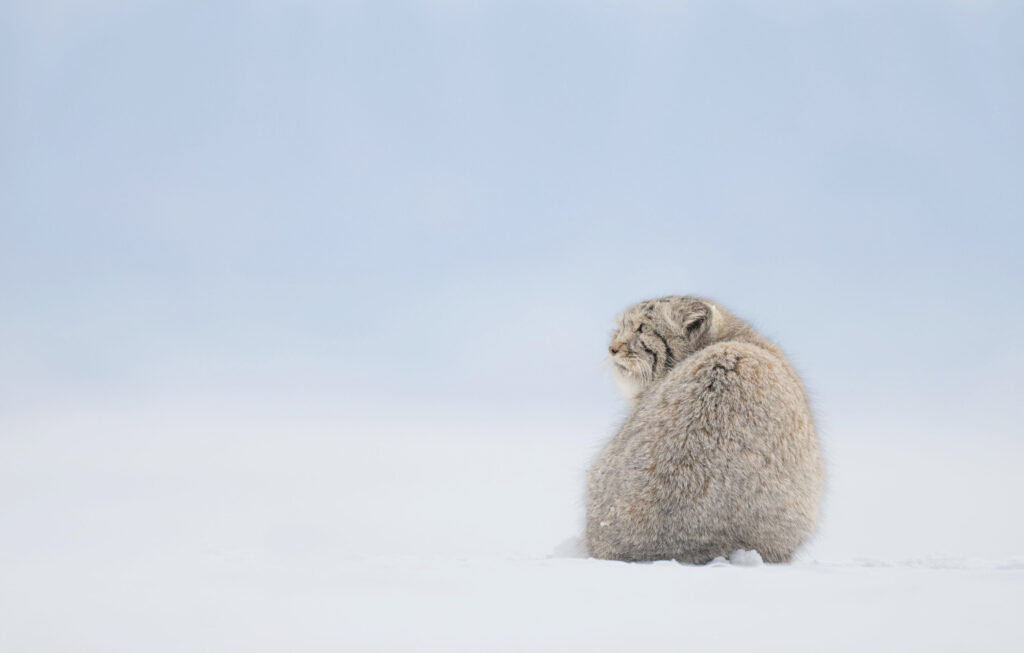
The Pallas’s cat (Otocolobus manul), also known as the manul, is a small wild cat with long and dense light grey fur. Its rounded ears are set low on the sides of the head. Its head-and-body length ranges from 46 to 65 cm (18 to 26 in) with a 21 to 31 cm (8.3 to 12.2 in) long bushy tail. It is well camouflaged and adapted to the cold continental climate in its native range, which receives little rainfall and experiences a wide range of temperatures. The Pallas’s cat has rounded rather than vertical slit pupils, a unique feature among small cats.
Physical description of the Pallas’s Cat
Pallas’ cats have the same thick, long fur, flat faces, and stocky build as domestic Persian cats. Their round ears are set low on their heads, so they can peer over rocks while keeping their ears hidden. Their coats range from tan to gray to an almost orange-red, sometimes changing with the seasons to help them blend into the landscape. They can have dark stripes, especially on their tails. Many of their hairs have white tips, giving their coats an almost frosted look.
Size of the Pallas’s cat
Pallas’ cats are about the size of small, stocky domestic cats. They are 20 to 24 inches long with an 8 to 10-inch-long tail and weigh between 4 and 11 pounds.
Native habitat
Pallas’s cats are found in Turkmenistan, Iran, Kyrgyzstan, Kazakhstan, Bhutan, Nepal, India, Pakistan, Afghanistan, China, Mongolia, and Russia. They live in shrublands, grasslands, deserts, and rocky areas.
Communication
Pallas’s cats yelp, growl, and purr. They use scent to mark their territories, which are unusually large for such small cats — about 3.5 to 7 square miles.
Food/eating habits
Pallas’s cats are carnivores. They eat mainly small rodents, including gerbils, voles, hamsters, pikas, and small marmots. They also eat small lizards and birds.
They ambush their prey rather than chase it, often waiting at the exits of rodent burrows or even sticking their paws in to try to scoop out their prey.

Social structure
Pallas’s cats are typically solitary in the wild. Pairs come together only for very short times to mate. A mother will stay with her kittens until they are ready to hunt independently, typically around 6 months old.
Reproduction and development
They have a short breeding season in the early spring when males and females come together to mate. About 74 to 75 days later, the female gives birth to three to six kittens.
The kittens are born blind and helpless and measure about 5 inches long. Their eyes open about three weeks later, and their mother teaches them to hunt.
Sleep habits
Pallas’s cats prefer to hide and sleep during the day and hunt at dusk, dawn, and night. They spend the days in shadowy crevices, caves, and burrows dug by other animals.
Lifespan
Pallas’s cats typically live to be 8 to 9 years old.
Decreasing population
The Pallas’s cat is classified as Near Threatened in the IUCN Red List and the National Red Lists of Kyrgyzstan, Mongolia, and Pakistan. In China and Turkmenistan, it is listed as Endangered. The species is listed as Extinct in Armenia and Azerbaijan.
If you want to photograph Pallas’s cats, contact us about our Snow Leopard and Pallas’s Cats photo tour at Akari Photo Tours.
Read Other Species Spotlight articles
If you’re as passionate about wildlife as we are, take a moment to explore our Species Spotlight series. Each article dives into the fascinating lives of the animals and birds we love to photograph on our workshops—whether it’s a puffin perched on a cliff in Newfoundland, a leopard draped across a tree in Tanzania, or an Adelie penguin waddling through the snow in Antarctica. It’s a growing library of stories, facts, and inspiration for anyone who dreams of capturing the wild through their lens. Come see the world the way we do—one species at a time.