Photographing From a Doors-Off Helicopter in Namibia
By Kevin Pepper |
There are a few moments on our Namibia workshops where people go quiet.
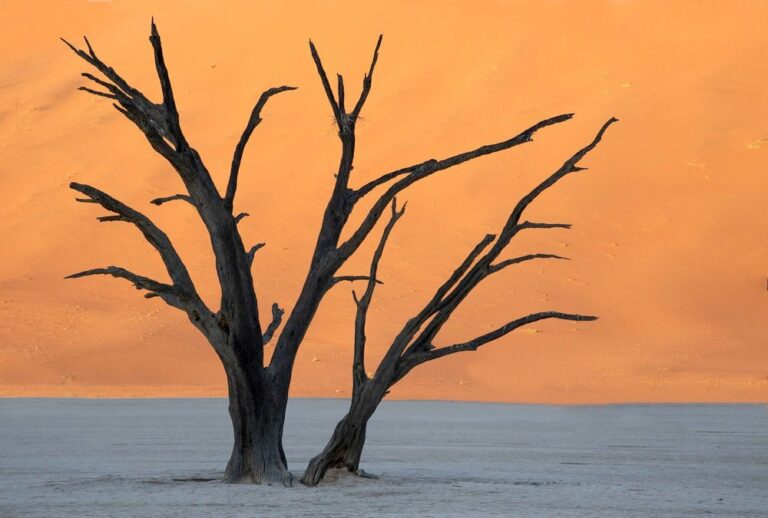
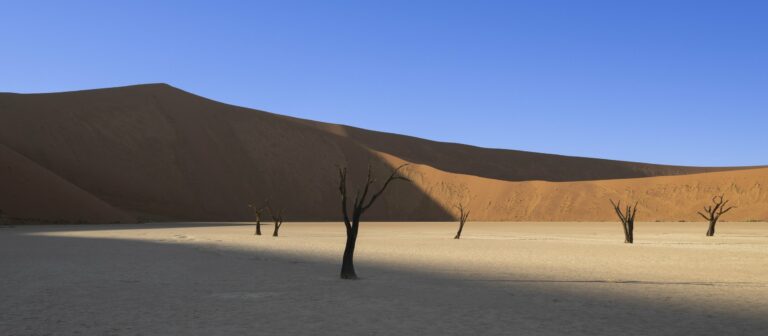
The first time they walk into Deadvlei is one.
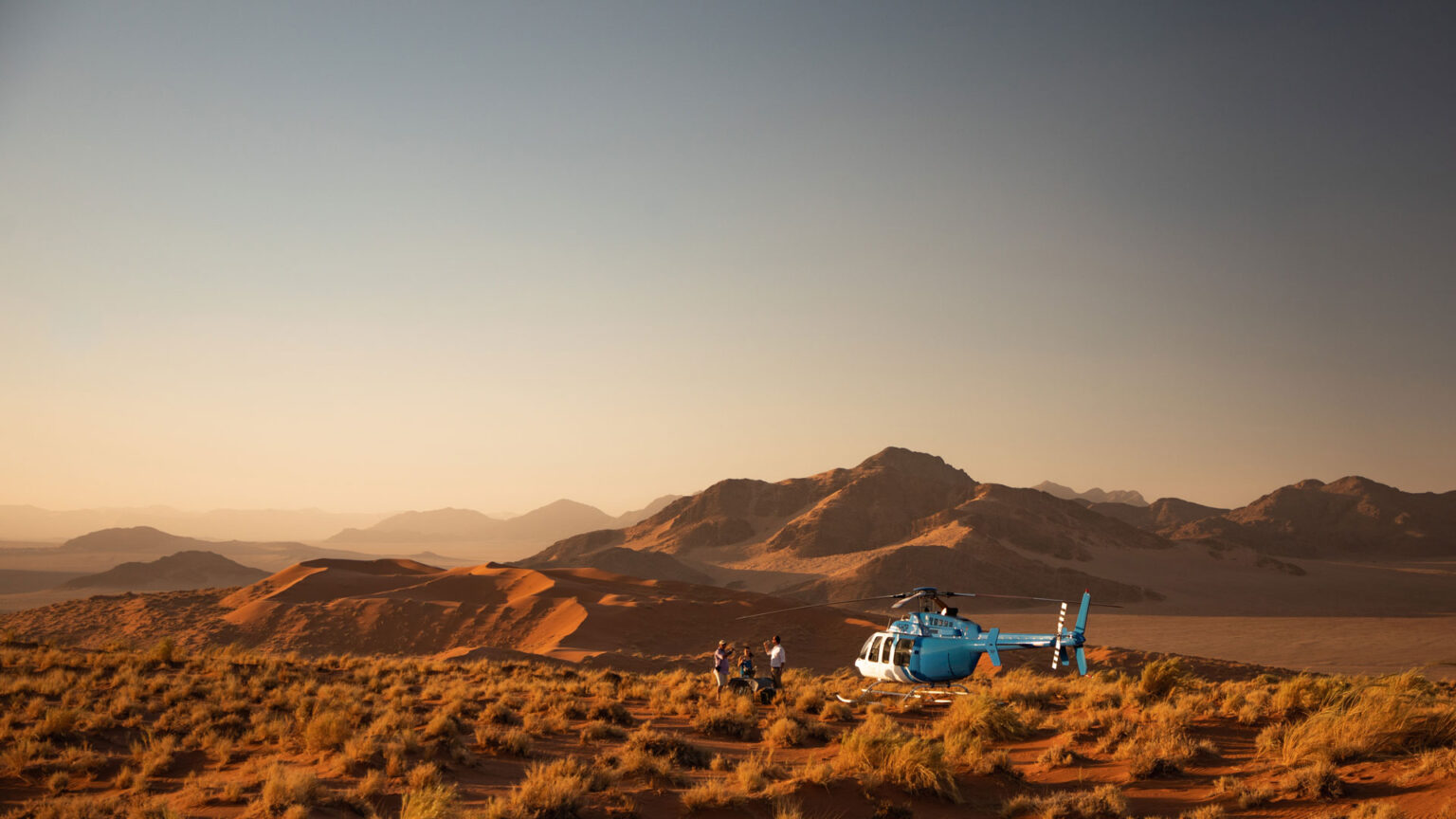
The first time the helicopter lifts off over Sossusvlei with the doors off is another.
From the ground, the Namib Desert is impressive. From the air, it becomes something else entirely. The dunes stop looking like dunes and start becoming patterns, brush strokes, waves, ridges, shadows, and lines that seem to go on forever. This is one of the most exciting photography experiences we offer in Namibia, but it is also one of the fastest moving. You do not have a lot of time to figure things out once you are in the air.
I’ve photographed these doors-off helicopter flights in Namibia multiple times, and the best advice I can give is simple: prepare before you lift off. Once the helicopter is moving, the light is changing, the landscape is shifting, and the compositions are appearing and disappearing in seconds.
Safety Comes First
Before we talk about shutter speeds, lenses, and compositions, we need to talk about safety.
A doors-off helicopter flight is not the place to improvise. Listen carefully to the pilot and ground crew. Their briefing matters. They will tell you where to stand, when to approach the helicopter, how to move around the aircraft, how to secure yourself, and what you can and cannot bring on board.
Loose items are the enemy. Hats, scarves, lens caps, loose straps, phones, tissues, wrappers, and anything that can fly away should be secured or left behind. Open-door helicopter operators commonly restrict loose clothing and loose accessories because the wind can pull items out of the aircraft quickly. That is not just inconvenient; it can become dangerous.
Your camera must be attached to you. I do not rely on a regular neck strap alone. When you are photographing downward, a neck strap can shift, slide, or get in the way. A secure cross-body strap, wrist strap, or tether system is a much better idea. The goal is simple: if your grip fails, the camera stays with you.
Do not change lenses during the flight unless the crew specifically allows it and conditions make it safe. In most cases, I strongly recommend you do not do it. There is wind, dust, vibration, and very little room. If you want two focal length options, bring two camera bodies instead of trying to swap lenses mid-flight.
Also, be careful with your body position. Do not lean out farther than instructed. Do not put arms, straps, or gear outside the aircraft in a way that could interfere with the helicopter. You are there to make photographs, not become a cautionary tale with a camera.
What Gear Should You Bring?
For most photographers, I recommend two camera bodies if you have them.
One body should have a wider lens for the big desert scenes. Something in the 16–35mm or 24–70mm range works well. This lets you photograph the sweep of the dunes, the patterns around Deadvlei, and the relationship between sand, shadow, and sky.
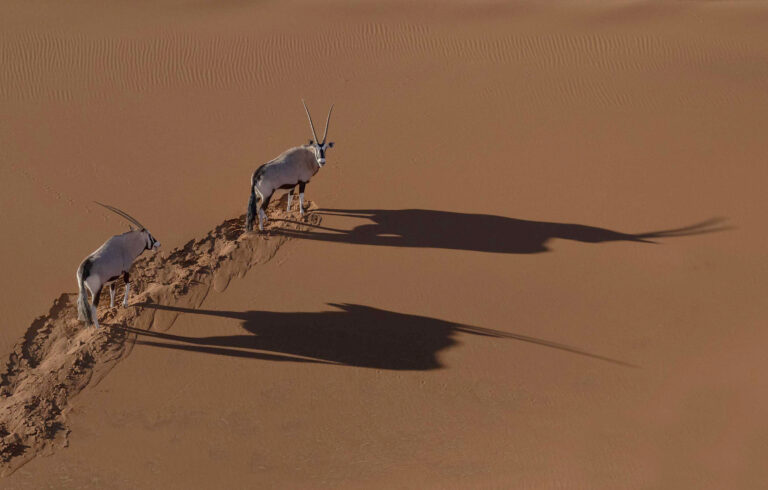
The second body should have a longer lens, something like a 70–200mm or 100–400mm. This is where the abstract images often happen. From above, a longer lens allows you to isolate dune ridges, compress layers, pick out wildlife tracks, photograph oryx or springbok if we see them, and create those clean graphic images Namibia is famous for.
Do not overpack. Space is limited, and too much gear quickly becomes a problem. I would rather have two ready-to-use cameras than a bag full of options I cannot safely access.
Bring fully charged batteries and empty memory cards. Sounds obvious. Still, someone always discovers a 94% full card at the worst possible time. That someone should not be you.
Camera Settings for Helicopter Photography
The helicopter is moving. You are moving. The subject is moving beneath you. The wind is moving. Even your excitement is probably moving.
Use a fast shutter speed.
As a starting point, I like to be around 1/3000 sec when possible. If the light is lower, I will try to stay above 1/2000 sec. This is not the place to worry too much about using a higher ISO. A sharp file with a little noise is far better than a soft file taken at ISO 100.
For aperture, I usually work around f/5.6 to f/8. You do not need extreme depth of field from the air, but you do want enough sharpness across the frame when photographing dune patterns and ridgelines.
For autofocus, use continuous autofocus. If your camera has subject tracking, it can help with wildlife, but for dunes and landscapes I usually keep it simple. I am looking for strong lines, clean edges, and contrast. The desert gives you plenty of that.
A good starting setup:
Shutter speed: 1/2000 to 1/3000 sec
Aperture: f/5.6 to f/8
ISO: Auto ISO or manually adjusted as needed
Focus mode: Continuous autofocus
Drive mode: High-speed continuous
Stabilization: On, unless your lens or camera manual recommends otherwise for aircraft vibration
Shoot in RAW. Namibia’s light can be bright, contrasty, and full of subtle colour shifts. RAW files give you more room to work with highlights, shadows, and the warm tones of the sand.
How to See Compositions in the Dunes
This is where the flight gets fun.
From the ground, we often compose using foreground, background, leading lines, and sky. From the air, you need to think differently. You are not just photographing a place. You are photographing shape.
Look for:
Lines
Dune ridges are the backbone of aerial desert photography. Watch for curves, diagonals, S-shapes, and ridges that divide light from shadow.
Shadows
The shadows are often more important than the sand. Early and late light gives the dunes dimension. Shadows create form, separation, and mood. Without them, the desert can become flat.
Patterns
Wind creates repetition in the sand. From above, these patterns can look like fabric, water, fingerprints, or brush strokes. Do not always look for the biggest scene. Some of the best photographs are small sections of the landscape.
Contrast
The white clay pans, red dunes, dark shadows, and occasional vegetation create strong natural contrast. Use that. A single tree, a line of tracks, or a dark ridge cutting through bright sand can become the photograph.
Scale
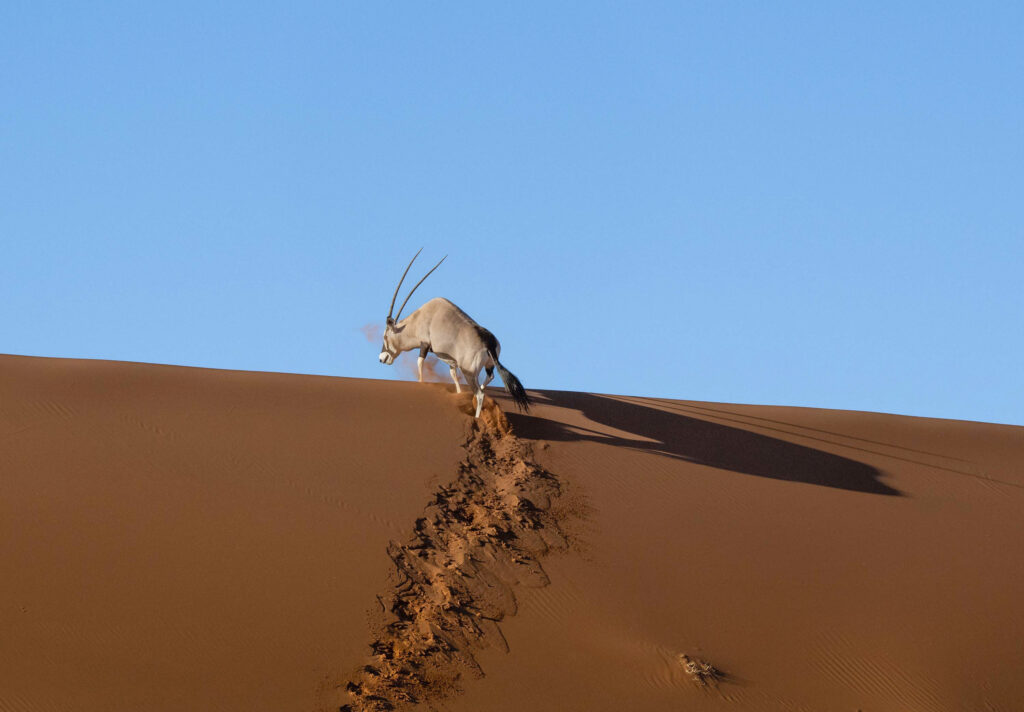
Namibia is enormous. To show that, include something small in the frame when possible. A vehicle track, an oryx, a tree, or even a tiny line crossing a dune can help people feel the size of the desert.
Sossusvlei sits inside Namib-Naukluft National Park, and the dunes in this area are among the highest in the world, reaching close to 400 metres. That scale is hard to understand from the ground. From the helicopter, it finally makes sense.
Photographing Wildlife From the Air
Wildlife from a helicopter is different than wildlife from a vehicle.
You are not looking for portraits. You are looking for wildlife in the landscape.
If we see oryx, springbok, ostrich, or other desert-adapted wildlife, the most interesting image is often not a tight frame of the animal. It is the animal moving through the desert. It is the small shape surrounded by sand. It is the track line behind it. It is the shadow beside it.
From the air, wildlife becomes part of the design.
Use a longer lens if you have one ready, but do not get tunnel vision. The story is often the relationship between the animal and the environment. Namibia does this better than almost anywhere.
Do Not Forget to Look
This sounds like strange advice in a photography blog, but I mean it.
Every photographer wants to come home with strong images. I do too. But do not spend the entire flight buried in the viewfinder. Look with your eyes first. The desert changes quickly from the air, and sometimes the best compositions are easier to recognize when you stop chasing every frame.
Watch how the light moves over the dunes. Watch how the helicopter angle changes the shapes. Watch for the moments when the landscape suddenly simplifies.
Then photograph.
Not every second needs to be a motor-drive moment. Your memory card does not need to sound like a woodpecker having a nervous breakdown.
Clothing for a Doors-Off Flight
This is Namibia, so people often think only about heat. That is a mistake.
A doors-off helicopter flight, especially early in the morning, can be cold. Add wind, altitude, and the open cabin, and it can feel much cooler than it did standing outside five minutes earlier. During Namibia’s dry season, evenings and early mornings can be cold, and warm layers are important.
Wear layers. A light base layer, fleece or insulated layer, and a wind-blocking outer layer is a good combination. Avoid loose scarves, loose hats, or anything that can flap around. If you wear sunglasses, make sure they are secure. Gloves can help, especially if your hands get cold easily, but make sure you can still operate your camera properly.
Closed-toe shoes are best. You will be around aircraft, sand, gravel, and uneven ground. This is not the time for sandals.
Also consider sun protection. Even with a cold wind, the desert sun is strong. Use sunscreen before the flight, but avoid getting it on your hands right before handling camera gear. Greasy buttons and lenses are not exactly a recipe for greatness.
A Note About Drones
People often ask why we do not simply use drones for these views.
In Namibia, drones require proper permissions, and there are restrictions around where and how they can be used. Drone operation around national parks, controlled airspace, lodges, and sensitive wildlife areas is not something to take casually. Prior approval and liability insurance may be required, and flight restrictions can include altitude, distance, and proximity to protected areas or aerodromes.
The helicopter is not just a workaround. It is part of the experience. It gives us reach, height, safety, legal access, and the ability to photograph a vast desert landscape in a way that would be difficult, restricted, or impossible otherwise.
What I Tell Our Guests Before We Fly
Here is the simple version.
Secure everything.
Use a fast shutter speed.
Bring only what you need.
Do not change lenses in the air.
Think in lines, shadows, shapes, and scale.
Photograph wildlife as part of the landscape.
Dress warmer than you think.
Listen to the pilot.
And every now and then, put the camera down and take in where you are.
The doors-off helicopter flight over Sossusvlei is one of those experiences that reminds you why photography still has the power to surprise us. You can study maps, look at images, watch videos, and think you understand the Namib Desert.
Then you lift off.
And suddenly the whole place opens beneath you.
Join us on a Namibia Photo Safari