Species Spotlight: Northern Jacana
By Kevin Lisota |
Introduction of the Species
The Northern Jacana is one of the most entertaining birds in Costa Rica’s wetlands. At first glance, it almost looks like a bird performing a magic trick, stepping lightly across floating vegetation as if solid ground were optional. For photographers, that alone makes it memorable. But once you spend a little time with one, you realize the real appeal goes beyond the novelty. It has elegant lines, rich color, unusual behavior, and the kind of presence that makes wetland photography feel every bit as rewarding as working in the rainforest canopy.
Physical Description
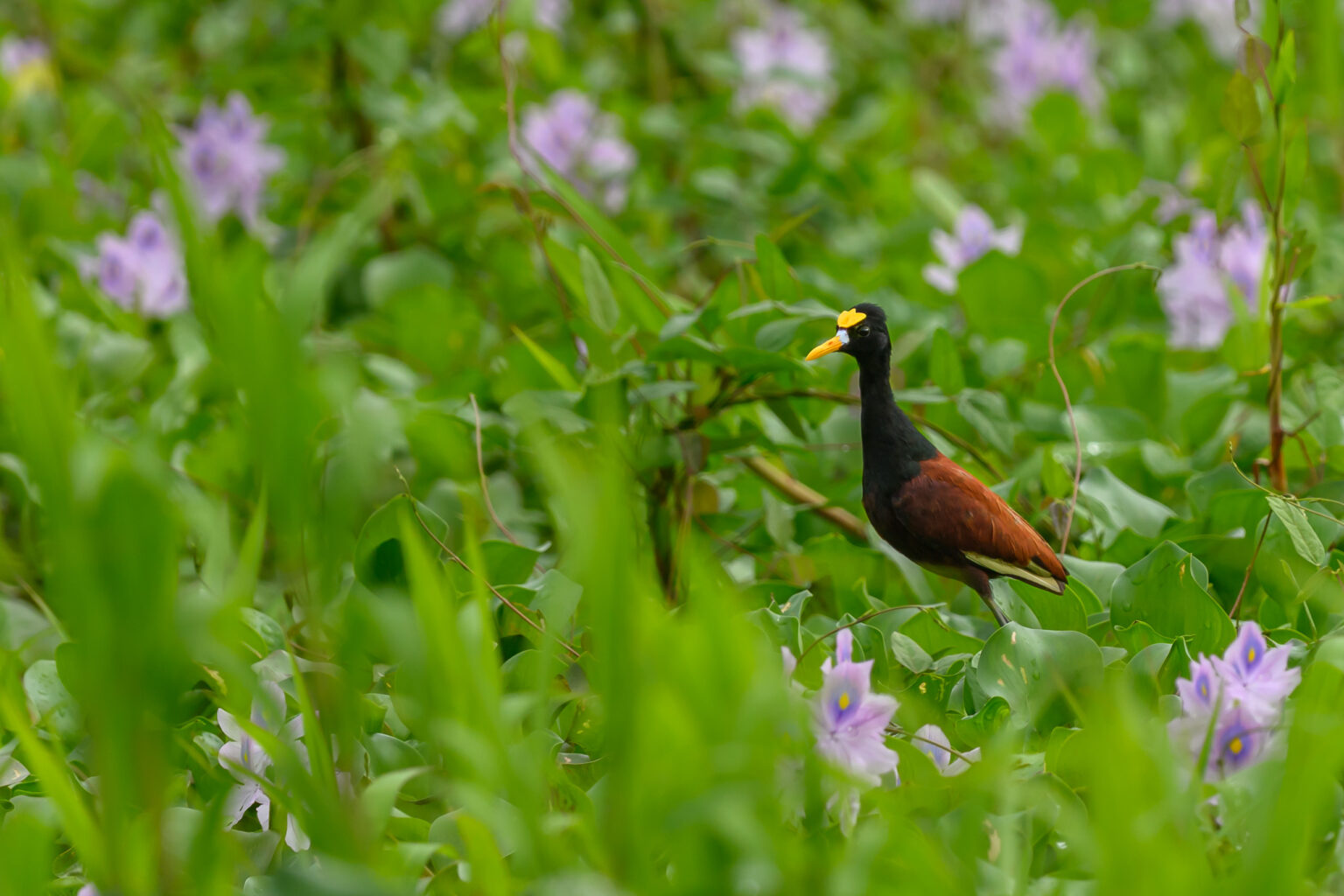
The Northern Jacana is a medium-sized wetland bird with very long legs and remarkably elongated toes that spread its weight across floating plants. Adults are dark overall, with a black head, neck, and breast, rich chestnut-maroon back and underparts, a bright yellow bill, and a yellow frontal shield at the base of the bill. In flight, the wings reveal yellowish to greenish-yellow flight feathers that add even more visual interest. Females are noticeably larger than males, which is a nice reversal of the usual bird pattern and one of several things that makes this species so fascinating.
Native Habitat
Northern Jacanas are birds of freshwater marshes, ponds, swamps, and shallow wetlands, especially places thick with floating vegetation such as lily pads and other aquatic plants. That habitat is the key to both their look and their behavior. Their oversized toes are not a quirky extra. They are the whole design. In Costa Rica, jacanas bring photographers into a side of the country many people overlook. Costa Rica is famous for rainforest birds, monkeys, sloths, and frogs, but its wetlands add a completely different set of subjects, colors, and compositions to a trip.
Where They Are Found in Central and South America
The Northern Jacana ranges from Mexico through Central America to Panama, and it also occurs on several Caribbean islands. It reaches into the edge of northern South America in broader regional discussions, but for practical website copy tied to Costa Rica, the strongest range description is Mexico through Central America to Panama. Costa Rica is one of the best places in that range to photograph the species well in good habitat.
Behavior in the Wild
This is where the Northern Jacana really starts to earn its reputation. It is often called a “lily-trotter” because of the way it walks across floating vegetation with startling ease. It also has one of the more unusual breeding systems in the bird world. Northern Jacanas are polyandrous, meaning a female may maintain a territory that overlaps with the territories of multiple males. The males do the bulk of incubation and chick care, while the larger females defend territories and breeding access. That role reversal alone is enough to make bird photographers and naturalists pay attention. It is a strange and wonderful bird, which, frankly, is often the best kind.
Food and Eating Habits
Northern Jacanas feed mainly on insects and other small invertebrates picked from the surface of aquatic plants and shallow water. Their diet can also include seeds, snails, worms, small crustaceans, mollusks, and occasionally tiny fish. They forage methodically, often moving with a kind of deliberate confidence that makes them rewarding to photograph. Unlike birds that flash past and dare you to keep up, jacanas often give you enough time to study their posture, refine your framing, and wait for that perfectly placed step across a lily pad.
Nesting and Breeding
The nesting life of the Northern Jacana is every bit as interesting as its feeding behavior. Nests are built on floating vegetation, usually low and close to the water’s surface. The eggs are darkly marked and surprisingly handsome, and after laying, it is the male that typically handles incubation and much of the chick care. The young are precocial, meaning they are able to move about soon after hatching. In a species already known for strange and impressive design choices, handing fatherhood the heavy lifting feels very on brand.
Why Photographers Love Them
Photographers love the Northern Jacana because it offers more than just a species checkmark. It offers behavior. It offers design. It offers the chance to make images that feel different from the usual tropical bird portraits. The long toes, reflective water, floating vegetation, chestnut tones, and graphic shape all combine into a subject that is both elegant and slightly bizarre. That is a strong combination. It also photographs beautifully in environmental compositions, which makes it especially appealing to photographers who want more than just a tight portrait on a stick.
Join Us in Costa Rica
Costa Rica gives photographers far more than rainforest birds. It gives you variety, and variety is part of what makes a strong portfolio. On our Costa Rica photo workshop, you are not limited to one kind of habitat or one kind of subject. You can photograph toucans in the canopy, frogs after dark, monkeys in the forest, macaws overhead, and wetland specialists like the Northern Jacana moving across lily pads like they own the place. Because, to be fair, they kind of do.
If you want a workshop that gives you colorful birds, strange wildlife, rich habitats, and real photographic variety, our Costa Rica photo workshop is exactly the kind of trip you should be looking at. The Northern Jacana is only one piece of the story, but it is a good one — and in the right light, on the right wetland, it is a very good reason to come with us.