Species Spotlight: Northern Emerald Toucanet
By Kevin Lisota |
Introduction of the Species
The Northern Emerald Toucanet is one of those birds that feels almost too polished to be real. It is compact for a toucan, dressed in rich green, and carries that oversized bill with the kind of confidence only a toucan can pull off. In Costa Rica, it is one of the birds that makes photographers stop mid-sentence, raise the camera, and suddenly become very focused on branch angles and background blur. Which is exactly how it should be.
Physical Description
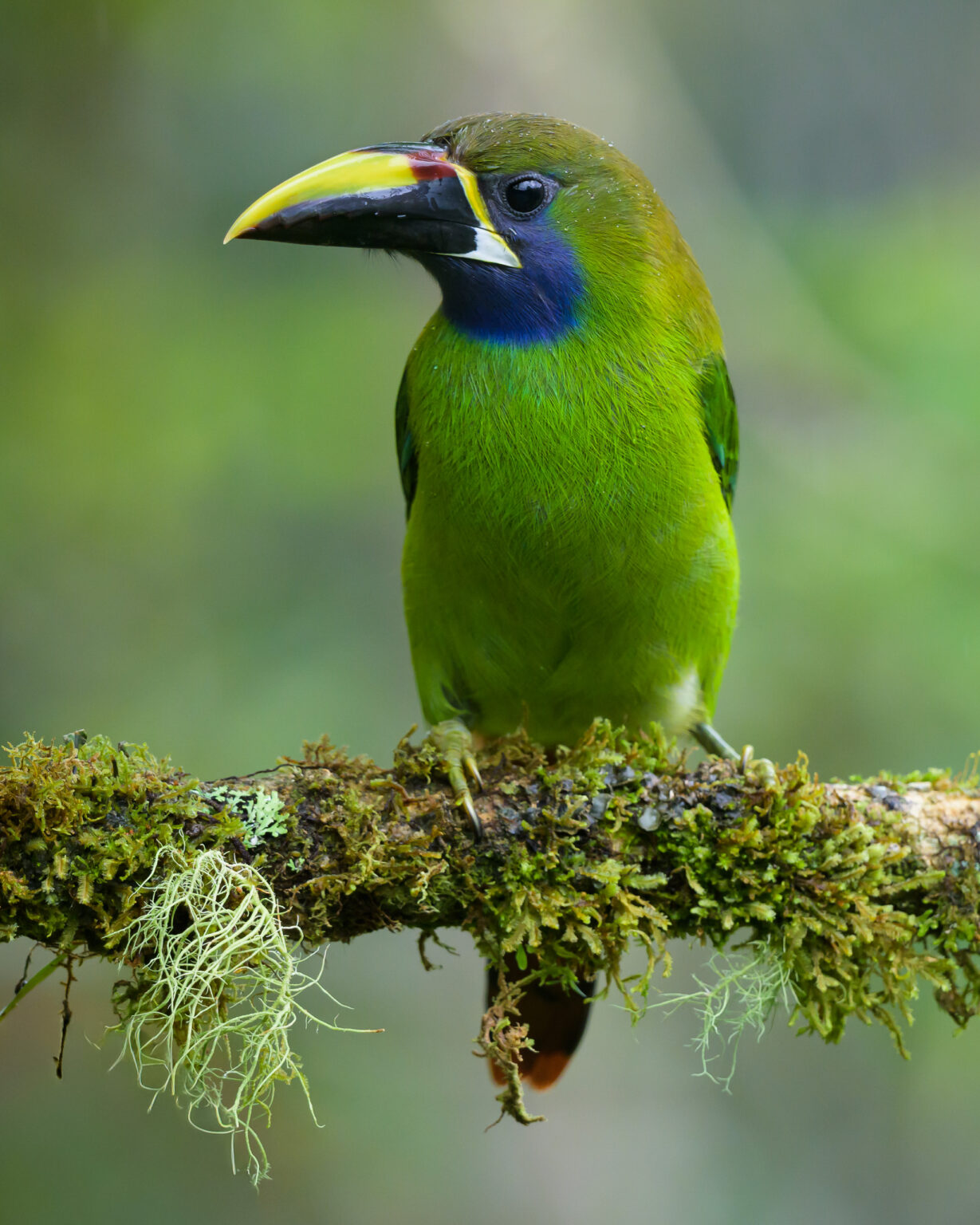
The Northern Emerald Toucanet is a small to medium-sized toucan, typically about 29 to 37 cm long and weighing roughly 150 to 240 grams. Adults are mostly green, usually a little lighter below than above, with a darker eye set in darker bare facial skin. The lower face and throat are white, the flanks show bright yellow-green tones, and the undertail coverts and underside of the tail are chestnut. The bill is especially attractive, with a yellow upper mandible, a black lower mandible, a black patch near the nostrils, and a pale vertical mark at the bill base. Females generally look similar to males but are usually a bit smaller and shorter-billed.
Native Habitat
This species primarily inhabits humid montane forest, but it is also found in more open habitats such as secondary forest, shrublands, plantations, and even pasture edges where suitable trees remain. Across its range it can occur from near sea level up to at least 3,000 meters, though in Costa Rica it is most strongly associated with greener, cooler upland habitats where mist, moss, and dense foliage give bird photography a wonderful sense of atmosphere. It is non-migratory, which is always a comforting quality in a bird you hope will cooperate.
Where They Are Found in Central and South America
The Northern Emerald Toucanet occurs in montane regions from southern Mexico to southern Panama. The Costa Rican birds belong to the highland Central American part of that range, extending into western and central Panama. Costa Rica is therefore one of the classic places to photograph the species in lush mountain habitat, where the whole setting feels as beautiful as the bird itself.
Behavior in the Wild
Northern Emerald Toucanets are described as gregarious and often gather in groups of up to about 10 birds. They usually forage while perched, moving through the canopy or mid-levels of the forest with deliberate, purposeful motions rather than frantic bursts. Their calls have been described as nasal, barking sequences and rough, throaty sounds that are not exactly musical, but they are useful. In tropical bird photography, beautiful birds do not always come with beautiful voices. The toucanets seem perfectly comfortable with that arrangement.
Food and Eating Habits
The Northern Emerald Toucanet has an impressively varied diet. It takes a wide range of fruits, but it also feeds on invertebrates and even some vertebrate prey, including birds, eggs, lizards, and snakes. It usually gleans food while perched rather than making dramatic aerial sallies. That mixed diet is part of what makes toucanets so successful, and it is also a reminder that tropical birds can be both beautiful and surprisingly practical about lunch.
Nesting and Breeding
The breeding season runs from about March to July. Northern Emerald Toucanets nest in tree cavities, either natural cavities or abandoned woodpecker holes, sometimes as high as 27 meters above the ground. Typical clutch size is three or four eggs, though clutches from one to five have been reported. Both sexes incubate, with the female reportedly taking the larger share, and fledging occurs about 42 to 45 days after hatching.
Why Photographers Love Them
Photographers love the Northern Emerald Toucanet because it gives them all the appeal of a toucan in a slightly more refined, highland package. The green plumage works beautifully against mossy branches and soft forest backgrounds, the bill adds shape and color without overwhelming the frame, and the mountain habitat often gives images a richer sense of mood. It is the kind of bird that feels especially satisfying when photographed well, because the best images are usually about more than the bird alone. They are about the whole setting — the cloud forest air, the branch, the color harmony, and that quiet sense that you are photographing something the forest made carefully.
Join Us in Costa Rica
The Northern Emerald Toucanet is exactly the kind of species that makes Costa Rica such a rewarding place to photograph. It is colorful, charismatic, and often found in the kind of lush habitat that makes every frame feel alive. If birds like this make your trigger finger a little itchy, our Costa Rica photo workshop is built for you. Join us and photograph toucanets, tanagers, parrots, frogs, monkeys, and more in one of the richest wildlife photography destinations in the Americas.