Species Spotlight: Yellow-throated Toucan
By Kevin Lisota |
Introduction of the Species
The Yellow-throated Toucan is one of Costa Rica’s great rainforest celebrities. It is large, loud, colorful, and impossible to ignore when it arrives in the canopy. For photographers, it is the kind of bird that can turn an ordinary morning into one of those moments you talk about for years. You hear the calls first, then see that oversized bill, that bright yellow throat, and suddenly everyone in the group starts moving a little faster. Gracefully, of course. Or at least with good intentions.
Physical Description
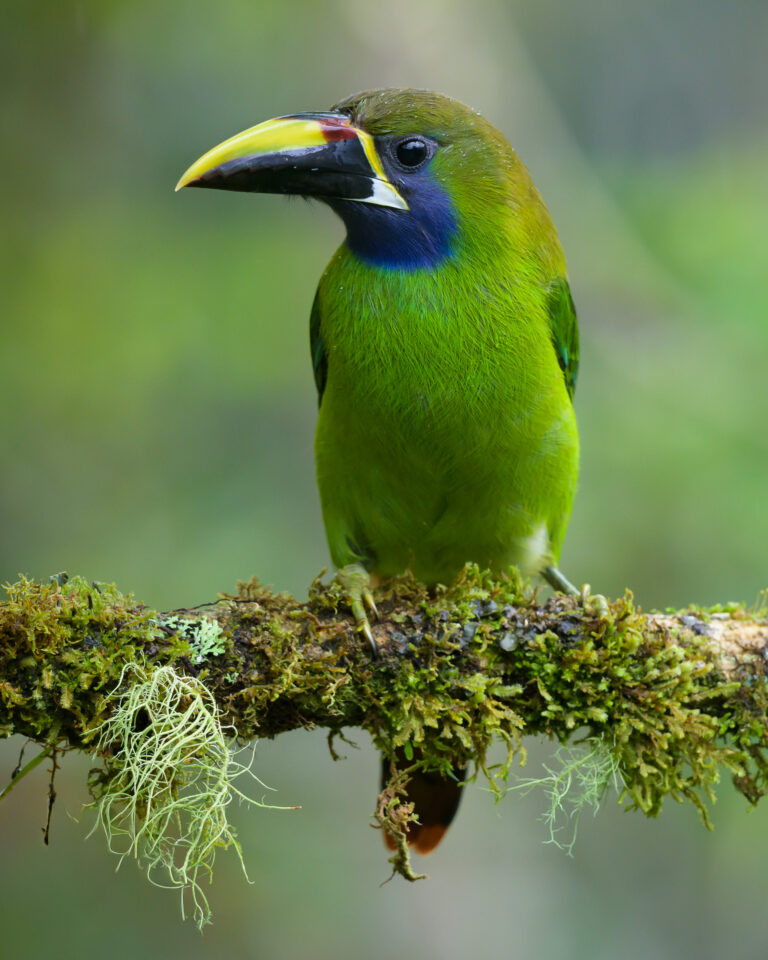
The Yellow-throated Toucan is one of the larger toucans found in the Neotropics. In Costa Rica, the chestnut-mandibled form shows a mostly black body with maroon tones in parts of the head and body, a bright yellow face and upper breast, a narrow white band and broader red band below the yellow, white upper tail coverts, red underparts near the vent, blue legs, and a striking bill that is yellow above and rich chestnut below. Males are generally larger than females, often reaching about 56 cm in length, while females are usually a bit smaller at roughly 52 cm. وزن is commonly reported in the roughly 599 to 746 gram range.
Native Habitat
This toucan is a bird of humid forest, especially moist lowland forest, forest edge, older secondary forest, and areas with fruiting trees near healthy forest cover. In Costa Rica, it is most often associated with richer, wetter habitats rather than dry forest. It can also use plantations and altered landscapes when fruiting trees are available, but it still depends heavily on forested environments. In Costa Rica, it is generally found from low elevations up to about 1,200 meters.
Where They Are Found in Central and South America
The Yellow-throated Toucan ranges from southeastern Honduras through Nicaragua, Costa Rica, and Panama, and continues into western Colombia, Ecuador, and farther south into Peru, depending on subspecies. The chestnut-mandibled form photographed in Costa Rica is the one that occurs from Honduras through Central America and into northwestern South America.
Behavior in the Wild
Yellow-throated Toucans are usually seen singly, in pairs, or in small groups, though small flocks are not unusual. They move through the canopy with an undulating flight and often travel in a loose, follow-the-leader pattern between trees. They are year-round residents rather than long-distance migrants, which is good news for photographers visiting Costa Rica. Their calls are loud, far-carrying yelps often rendered as “Díos te dé te dé,” and they are especially vocal around dawn and dusk. In many cases, you will hear them well before you ever get a clean view.
Food and Eating Habits
Like many toucans, the Yellow-throated Toucan is primarily a fruit eater, foraging mostly in the canopy. It hops from branch to branch, reaches for fruit with that oversized bill, and may even hang upside down to grab a meal. But it is not strictly a fruit specialist. It also eats insects and other arthropods, small lizards, frogs, eggs, and young birds, with much of the animal matter apparently being fed to nestlings. That makes it a more opportunistic and adaptable feeder than many people first assume. In plain English, it is beautiful, tropical, and occasionally a bit ruthless. Nature likes complexity.
Nesting and Breeding
The breeding season varies across its range, but in Costa Rica it has been reported mainly from March through June. Yellow-throated Toucans nest in tree cavities, usually natural holes formed by rot, though they may enlarge an existing cavity. The nest is often placed well above the ground, and the clutch is thought to be two or three eggs. Both parents help defend the nest and care for the young. Newly hatched chicks are blind, naked, and equipped with special pads on their heels that help protect them from the rough floor of the nesting cavity.
Why Photographers Love Them
There are birds you enjoy seeing, and then there are birds that make you lift the camera before your brain has fully caught up. The Yellow-throated Toucan belongs firmly in the second category. It has size, color, character, and presence. It photographs beautifully in profile, works well as an environmental subject in the canopy, and can also make for striking behavior images when feeding or calling. Because it often perches high and moves between fruiting trees, it is a terrific subject for practicing exposure, composition, background control, and patience. Sometimes all at once. Which is the rainforest’s way of keeping us humble. The species is also currently considered Near Threatened, with habitat loss and forest conversion among the main pressures on its population.
Join Us in Costa Rica
If the Yellow-throated Toucan is on your list, Costa Rica is one of the great places in the world to photograph it. And this is exactly why our Costa Rica photo workshop is built the way it is. We do not just show up and hope for luck. We put photographers in rich habitat, work through the light, and help you be ready when a bird like this suddenly lands in the open for just a few precious seconds.
And that is the real difference. Seeing a toucan is wonderful. Photographing one well is better. Photographing one well while surrounded by scarlet macaws, trogons, monkeys, frogs, sloths, tanagers, and all the green chaos that makes Costa Rica so addictive? That is a trip worth taking.
If you want rainforest color, tropical atmosphere, and wildlife subjects that make you feel like a kid with a camera again, come join us on our Costa Rica photo workshop. The toucans are waiting, and they are not getting any less photogenic.