
Spirit Bear Photo Workshop Trip Report
By Kevin Pepper |
A mix of anticipation, hope, and the quiet question every photographer knows well: what will I come back with?
This time, my destination was Spirit Bear Lodge, deep in the Great Bear Rainforest of British Columbia, in the community of Klemtu on Swindle Island, home of the Kitasoo Xai’xais people. The Kitasoo/Xai’xais First Nation owns and operates the lodge, and from the start, it feels like more than just a wildlife trip. It feels rooted in something older, wilder, and far more meaningful.
For photographers, this is not just another destination. This is one of those rare places that still feels truly untamed.
The Great Bear Rainforest is one of the largest remaining tracts of temperate rainforest on earth, stretching across roughly two million hectares of coastal wilderness. Here, thousand-year-old cedars stand like sentinels, 90-meter Sitka spruce rise into the mist, and salmon-rich rivers carve through the valleys below. This is the kind of landscape that feels cinematic before you ever lift the camera to your eye.
And then there is the wildlife.

Orcas. Humpback whales. Bald eagles. Coastal wolves. Black bears. Grizzlies. And, if fortune smiles on you, the rare Kermode bear — better known as the Spirit Bear.
For those unfamiliar with the Spirit Bear, it is one of the world’s rarest animals, found only in a small part of coastal British Columbia. It is not a separate species, but a white-coated form of the black bear, created by a rare recessive gene. They are not albinos. Their coats are cream or white, but their eyes and noses remain dark. That contrast only adds to their striking appearance. They look almost unreal when seen against the dark timber, wet stones, and emerald moss of the rainforest.
And for a photographer, seeing one is not just exciting. It is the kind of moment that stays with you.
Population estimates vary, but the numbers are low. Very low. The Kitasoo/Xai’xais territory is home to the largest proportion of Spirit Bears anywhere and the only Spirit Bear conservancy. In other words, if you dream of photographing one of these bears in the wild, this is the only place on earth to do it.
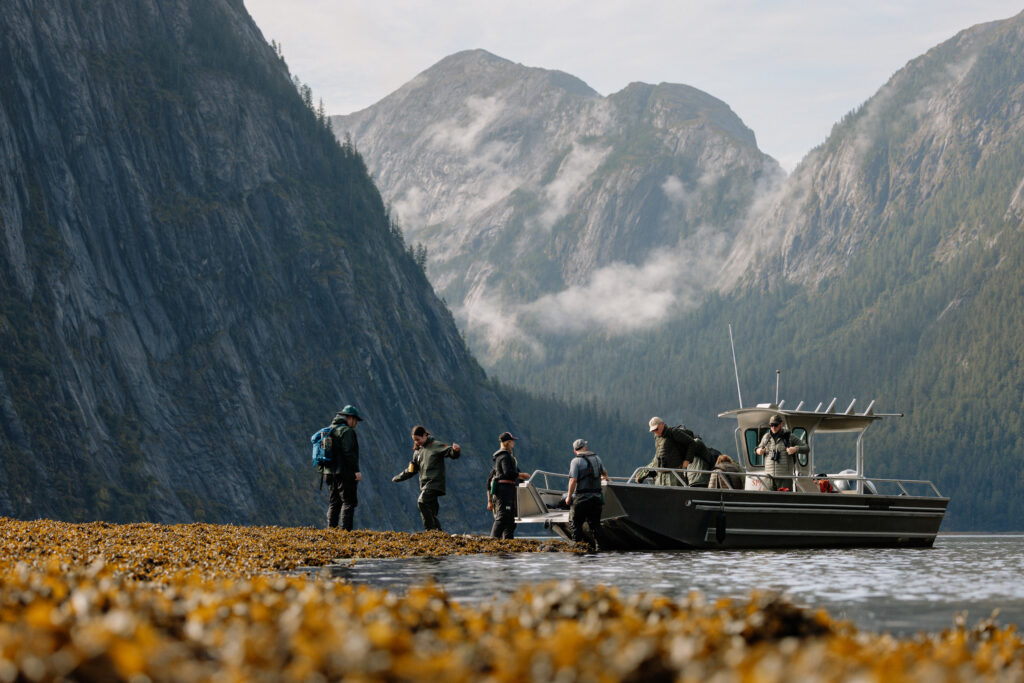
Our trip began at Vancouver’s South Terminal, where we boarded a regional flight north to Bella Bella. Even that leg of the journey felt like part of the experience. The flight alone offered remarkable coastal views—islands, inlets, mountains, and water twisting together in that unmistakable West Coast way. From Bella Bella, we transferred to the docks and boarded a boat for the ride to Klemtu, winding through beautiful waterways toward Spirit Bear Lodge, which would be our home for the next four nights.

The lodge itself is welcoming, comfortable, and thoughtfully designed. Its exterior pays tribute to traditional west coast longhouses, while the interior is modern and warm without losing its connection to place. After long days on the water and in the estuaries, it was a pleasure to come back to a hot meal, a comfortable room, and a deck overlooking the sea. There is something deeply satisfying about downloading images from the day while sipping a glass of wine or a craft beer and trading stories with other photographers who understand exactly why a single wild encounter can carry so much weight.
Each day began with real anticipation.
After breakfast, we headed out eager to see what the rainforest and coastline would give us. Our target list was ambitious: black bears, grizzlies, Spirit Bears, coastal wolves, bald eagles, osprey, Harlequin Ducks, Pacific Loons, humpback whales, and orcas. For photographers, that kind of diversity is hard to ignore. You are constantly shifting between wildlife portrait opportunities, behavior, landscapes, and the kind of layered environmental scenes that tell a bigger story.
The first day started slowly. We spent time with humpback whales, then moved into one of the estuary systems where both black bears and grizzlies are often seen. And of course, anywhere there are black bears in this region, there is always that quiet possibility that one of them might be white.
We photographed a grizzly, which is hardly something to complain about. A grizzly in the wild is always a thrill. But the Spirit Bear stayed hidden on day one.
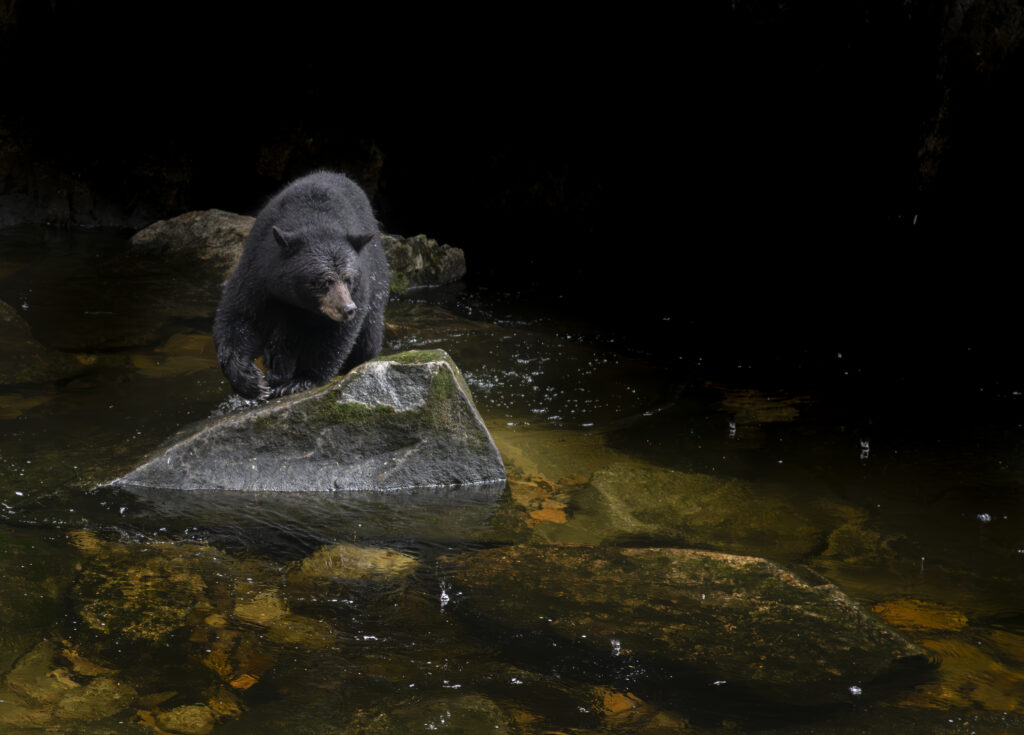
Day two brought us into a beautiful creek system in the rainforest, and it was the kind of setting photographers dream about — soft light, rich greens, still water, and a black bear moving through a salmon stream. It was one of those scenes where even without the “headline” species, the experience still felt worthwhile. Beautiful habitat, strong compositions, and a subject perfectly suited to the location.
Still, we all knew this creek had recently been productive for Spirit Bears.
When you spend a full day in a prime location and come up empty, the doubt starts creeping in. Quietly at first. Then a little louder.
By day three, we were back out with renewed optimism and plenty of coffee-fueled determination. We made our way to an estuary I had seen in lodge photographs before the trip. Soon after arriving, we spotted a bear in the distance and headed over by zodiac. What we found instead was a mother grizzly with three cubs less than a year old.
Not a bad consolation prize.
We followed them along the river’s edge for quite a while, watching the cubs stick close while their mother moved with that mix of power and calm that only grizzlies seem to manage. The experience ended with the mother swimming and then leading the cubs into cover to nurse. From a photographic standpoint, it was excellent. Emotionally, it was one of those encounters that reminds you why patience matters.
Then we returned to the lodge.
That is when we learned that the group who had gone to our creek from the day before had spent the entire day with a Spirit Bear.
You could feel the air go out of the room.
The disappointment was immediate and impossible to hide. Wildlife photography can be like that. Timing is everything, and sometimes the difference between “almost” and “we got it” is one decision, one tide, or one bend in the river. Still, by dinner, the group pulled itself together. We reminded ourselves that this is part of wild photography. No guarantees. No staged moments. Just persistence, good attitudes, and the willingness to keep showing up.
What the group did not know was that I had quietly gone to the lodge team and guides to ask whether there was any way we could give ourselves one last serious chance in that creek system. We worked out a compromise for the final full day — not exactly the original plan, but enough to put us back in the game.
And that final day delivered.

We woke up hopeful, loaded our gear, and headed out under the kind of quiet optimism that photographers learn to protect. Before long, we heard reports of orcas in the area. For more than an hour, we followed a small pod against a backdrop of coastal mountains. That alone would have made the day worthwhile.
Then came the radio call.
A Spirit Bear had been seen in the creek.
As we entered the calm bay where the river spilled down from the mountains, there she was.
A white bear on the shoreline, moving through the low tide like something imagined rather than real. She stopped now and then, looked around, and gave us those rare, gracious pauses wildlife photographers live for — enough time to compose, adjust, breathe, and really take in the moment rather than panic-shooting 500 frames of pure adrenaline. The dark shoreline, muted water, and rainforest beyond made the perfect backdrop. It was one of those encounters where subject, setting, and emotion all came together at once.
That was the moment everyone had come for.
And it was worth the wait.
On our final morning, we packed up and began the long journey home. But British Columbia had one more card to play. A humpback whale decided to keep us company for nearly two hours, giving us fin slaps, deep dives, and even bubble-net feeding. Not a bad farewell.
Trips like this are hard to explain to people who do not photograph wildlife. They hear “bear trip” or “boat-based lodge” and think they understand it. But photographers know better. We are chasing more than sightings. We are chasing atmosphere. Behavior. Light. Gesture. Mood. The kind of image that carries the feeling of a place, not just proof that we were there.
Spirit Bear Lodge offers that in abundance.
It is a place where the landscape is every bit as compelling as the wildlife, where every day feels uncertain in the best possible way, and where the possibility of photographing one of the rarest bears on earth keeps your senses just a little sharper from sunrise to sunset.
I remember thinking that I would go back in a heartbeat. That day is finally happening. We are headed back to the Great Bear Rainforest in the fall of 2028.
If a trip like this speaks to the kind of photographer you are — someone who values wild places, meaningful encounters, and the chance to create images with real atmosphere and story — then this is a destination worth putting on your list.
I hope to see you there one day, camera in hand, rain jacket zipped up, memory cards ready, and optimism fully intact.
Because in a place like the Great Bear Rainforest, magic has a habit of showing up at any time.
Join us for our next photography workshop for the Spirit Bear. See our Great Bear Rainforest photo workshop.


