How to anticipate predator behavior in Africa
By Kevin Pepper |
What wildlife photographers should watch for before the action starts
There are few things in wildlife photography more thrilling than the moment a calm African plain stops feeling calm.
One minute, everything looks ordinary. A herd is grazing. Zebras are spread loosely across the grass. Impalas seem relaxed. A lion is lying low. A cheetah appears uninterested. The scene feels still, almost lazy.
Then something changes.
A few heads rise at once. Ears lock forward. Bodies tighten. The predator that looked half asleep is suddenly very awake. The air seems sharper. The mood shifts. And if you have spent enough time on safari, you start to understand something important: the hunt usually begins long before the chase.
For photographers, that matters.
Anyone can react when dust starts flying. But the strongest wildlife images are often made by photographers who saw the tension building before the action. They noticed the signs early. They were already in position. Their camera settings were ready. They were not scrambling as the scene unfolded before them.
That is one of the great lessons of photographing wildlife in Africa. The action is exciting, but anticipation is what makes the image.
The first clues often come from the prey
Most photographers watch the predator first. That is natural enough. Lions, leopards, cheetahs, wild dogs, hyenas, and jackals pull your attention immediately. They should. They are powerful, beautiful, and full of possibility.
But if you want to anticipate a hunt, you also need to watch the prey.
In many cases, the prey animals will tell you that something is wrong before the predator makes its move. A herd that was feeding casually may suddenly stop. Several animals may stare in the same direction. A few may shift their bodies to angle for escape. Others may begin to bunch together more tightly. Tails may flick. Heads may rise and stay raised. The mood changes from relaxed to alert.
That is when photographers need to stop chatting, stop reviewing old frames, and start paying attention.
It does not always mean a hunt will happen. Africa has a way of humbling anyone who starts acting too certain. But when prey behavior changes, there is often a reason. Learning to read that tension is one of the most useful field skills a wildlife photographer can develop.
What predator body language tells you
Different predators hunt in different ways, but there are common signs that tell you when casual behavior is turning into intent.
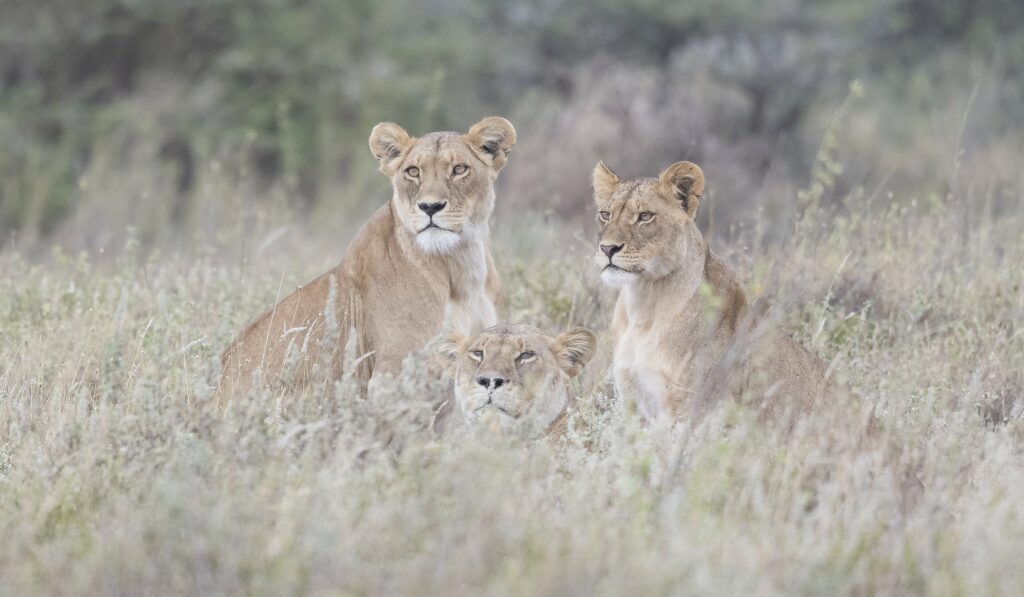
A lioness that has been resting may begin to lower her head and focus on a certain area of the herd. Her posture changes. She may begin using grass, dips in the terrain, or bushes for cover. The relaxed cat disappears, and what you are seeing now is calculation.
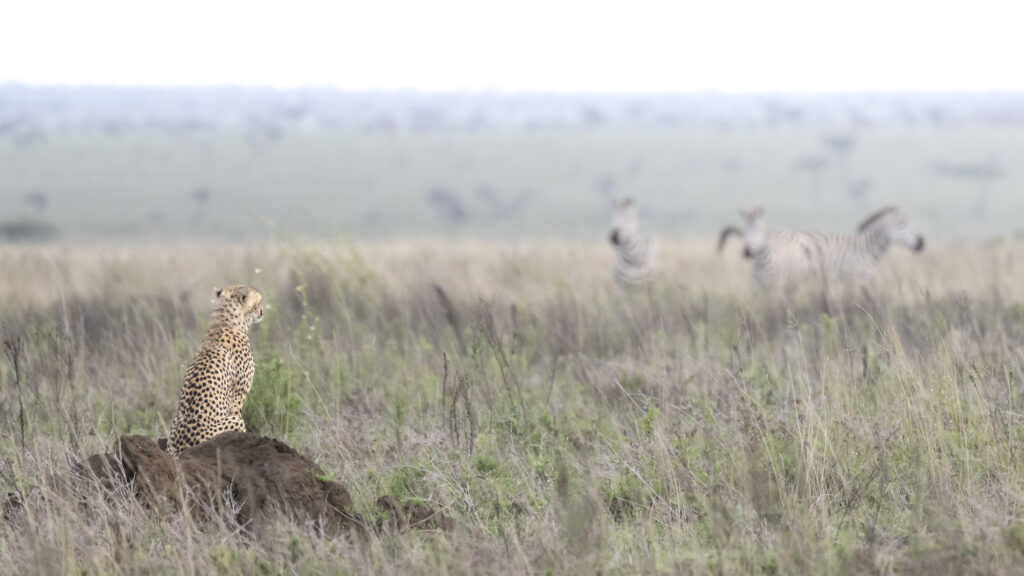
A cheetah often becomes more deliberate. It may rise, scan, and begin moving with purpose. The pauses become more meaningful. The posture tightens. Cheetahs can seem calm right up until the moment they decide the chase is on, so it is important to watch for those subtle changes in focus.
Leopards, when visible, can show the same kind of intent. Their body language becomes concentrated. The head locks in. The shoulders look loaded. They begin to use shadow and cover with more care.
Wild dogs are often more animated. You may notice rising excitement, social energy, regrouping, and a sudden sense of shared purpose. When the pack begins moving with clear focus, things can happen quickly.
Hyenas deserve more respect than they often get from photographers. They are sharp, opportunistic, and constantly assessing weakness or confusion. A hyena hunt may not always look the way people expect, but they are always reading the situation.
Across all these species, one sign matters more than most: intention. When a predator stops merely existing in the landscape and starts solving a problem, the scene is changing.
Read the wind, the terrain, and the mood of the scene
A hunt is not just about predator and prey. It is about the whole stage.
Wind matters. If prey animals catch scent, the opportunity may be gone before it begins. If the predator has the wind in its favor, the odds improve. You may not always feel the wind from the vehicle, but you can often read it in the grass, drifting dust, or the way animals are oriented.
Terrain matters just as much. Predators use cover beautifully. A slight rise, a termite mound, a patch of long grass, a shadow line, a riverbank, a depression in the ground — all of these can become tools in the stalk. Even open-looking country often has enough structure to matter.
Light matters too, both for behavior and for photography. Early morning and late afternoon often give us the best combination of active animals, softer light, and more dimensional scenes. Midday can still produce action, but the light is harder, and the contrast is less forgiving.
The photographers who do well in these moments are usually not just watching the animal. They are reading the landscape, the spacing, the light, and the tension across the whole scene.

Where to position yourself for better predator-prey images
Position is everything.
A great moment with poor positioning often turns into a documentary image. A great moment with smart positioning can become something much stronger.
The key is to think ahead. Do not just position yourself where the predator is right now. Try to position yourself where the story may unfold. That means thinking about the direction of the stalk, the likely escape route of the prey, the angle of the light, and the background you may get if the action starts.
Clean backgrounds still matter, even in the middle of chaos. In fact, they matter more. Predator-prey scenes get messy very quickly, so if you can give yourself a better angle before the action starts, you give yourself a much better chance of making a clean, readable frame.
Being too close is another common mistake. When the action erupts, a vehicle parked too tightly can actually hurt your chances. Animals can move out of frame instantly. You can lose room to track. You can end up too tight to include the relationship between hunter and hunted. Sometimes, backing off just a little gives you more room to tell the story properly.
It also helps to think beyond the first second. A hunt is not one frame. It is a sequence. Tension. Movement. Reaction. Chase. Contact or escape. Recovery. Dust. Breath. Regrouping. Positioning well means giving yourself a chance to photograph more than the launch.
Camera settings to have ready before the hunt begins
This is where many moments are lost.
Not because the photographer lacks skill. Not because the camera is not capable. But because the settings are still left over from a portrait taken ten minutes earlier.
Predatory action happens fast. Your camera needs to be ready before the chase begins.
For autofocus, use continuous autofocus. Your camera needs to track movement as animals approach, move away, or cross the frame at speed.
For the focus area, choose a mode that gives you some flexibility without becoming so wide that the camera starts grabbing grass, branches, or the wrong animal. The exact option depends on your camera body, but it’s worth practicing before your safari, not during it.
Shutter speed matters a lot. A useful starting point looks like this:
- 1/2000 sec or faster for explosive action, cheetah chases, wild dogs, or sudden contact
- 1/1600 sec is a strong working speed in many action situations
- 1/1000 sec only when movement is slower or the light is limited, and you need a compromise
For aperture, think about the scene in front of you:
- f/4 to f/5.6 works well when isolating a single predator or simplifying the background
- f/6.3 to f/8 is often better when predator and prey may fall on slightly different planes, or when multiple animals may enter the frame
ISO should be used without fear. Too many photographers hesitate to raise the ISO, missing the photo because their shutter speed is too slow. A little noise is far easier to forgive than motion blur in the one sequence you came all this way to photograph.
High-speed burst mode helps, but it still pays to be disciplined. A controlled burst at the right moment usually beats thousands of frames fired blindly. Timing still matters. So does staying with the subject through the sequence rather than just holding the button and hoping the camera sorts out your life.
A strong starting setup for wildlife action
When I think a hunt may happen, I want photographers ready with something close to this:
- Continuous autofocus enabled
- Subject detection on, if your camera handles wildlife well
- High-speed continuous burst
- Shutter speed around 1/2000 sec
- Aperture around f/5.6 or f/6.3
- Auto ISO with a sensible upper limit, or manual ISO if the light is steady
- Exposure compensation checked for bright grass, pale sky, or dark subjects
- A lens choice that is long enough for reach, but not so tight that you lose the story
That last point is important. A lot of photographers stay too tight on safari. Long lenses are excellent, of course, but predator-prey interactions often unfold fast and across space. Some of the strongest images are not the closest. They are the ones that include enough environment and spacing to show the tension between the two animals.
Exposure mistakes that cost you the image
One of the most common problems during a hunt is forgetting that the background may change quickly.
A predator may move from golden grass into darker brush. Prey may break into open sand, reflective water, or bright sky. If your exposure is not being watched, the scene can shift right when the action peaks.
Modern cameras are very good, but they are still easy to fool in African light. White bellies, black manes, pale dust, dark shadows, and hard sun can all create problems if you are not paying attention.
This is another reason anticipation matters so much. The more prepared you are before movement begins, the less likely you are to be caught behind the moment.
And once the action builds, stop looking at the back of the camera. The last frame is not going anywhere. The next one might be the reason you came.

Do not ignore what happens before and after the chase
Many photographers focus only on the chase itself. That is understandable. It is fast, dramatic, and full of adrenaline.
But some of the most meaningful images happen before the chase begins or after it ends.
The stare of a nervous impala. The crouch of a lioness in long grass. A cheetah standing tall and scanning. Dust hanging in the air after a failed chase. A predator panting. A herd regroups. Vultures circling. Cubs arriving. Wild dogs interacting after the run.
These moments add story. They add emotion. They show more than motion. And often, they are the images that feel strongest later because they capture the full rhythm of what happened, not just the loudest second.
Wildlife photography is not only about the impact point. It is about building a visual narrative.
Ethics matter more than the photograph
No image is worth influencing the outcome of a hunt.
Vehicles should never pressure predators into action, block prey’s escape routes, or force animals into more dramatic situations. Good guides and experienced photography leaders know how to position properly without interfering with natural behavior. That is better for the animals, the experience, and the images.
Natural behavior always photographs better than manipulated behavior. Always.
Africa does not need our help creating drama. It has been doing that just fine for a very long time.

Why this skill changes the way you photograph on safari
Learning to anticipate predator-prey behavior changes safari photography completely.
You stop feeling like action is random. You begin to notice clues. You become calmer. You prepare earlier. You make better decisions. You start understanding that wildlife photography is not just about reacting quickly. It is about seeing more deeply.
That is one of the major benefits of joining a true photography safari. You are not just being driven around hoping for luck. You are learning how to read behavior, understand the scene, anticipate movement, and prepare your camera before things happen. Those lessons stay with you long after the safari ends.
And once you begin to understand the rhythm of the hunt, Africa becomes even more fascinating. You realize that these moments are not simply chaos. They are strategy, tension, patience, failure, survival, and instinct playing out in real time.
For a photographer, there are few things more powerful to witness.
Join us in Africa
If photographing predator-prey behavior in Africa is on your list, we would love to have you join us on one of our African photo safaris.
This is the kind of photography that rewards preparation, patience, and time in the field. We work in small groups, use photography-first planning, and help our guests understand not just what is happening, but what may happen next. That matters when the herd is nervous, the light is falling into place, and a cheetah suddenly decides the moment has arrived.
Because on safari, the best action images do not begin when the chase starts.
They begin when you learn to see it coming.