Photographing China’s Yellow Mountains: Granite Peaks, Ancient Pines, and Changing Light
By Kevin Pepper |
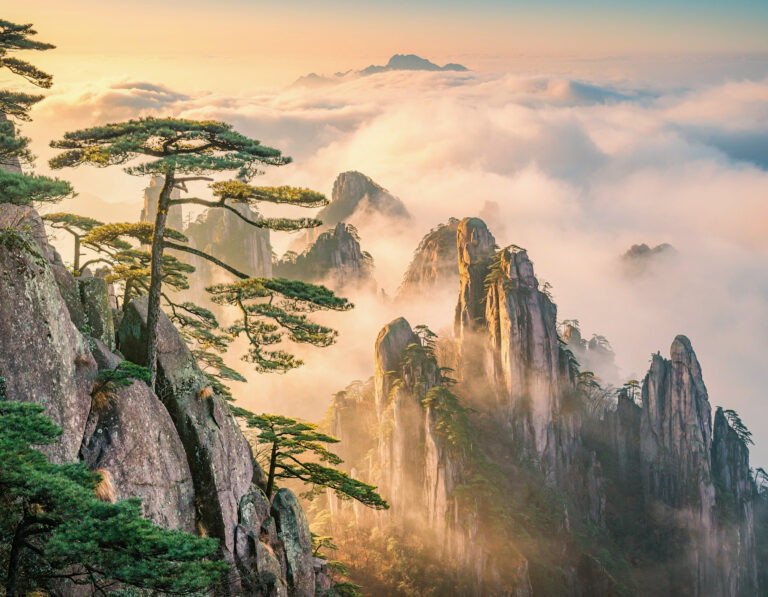
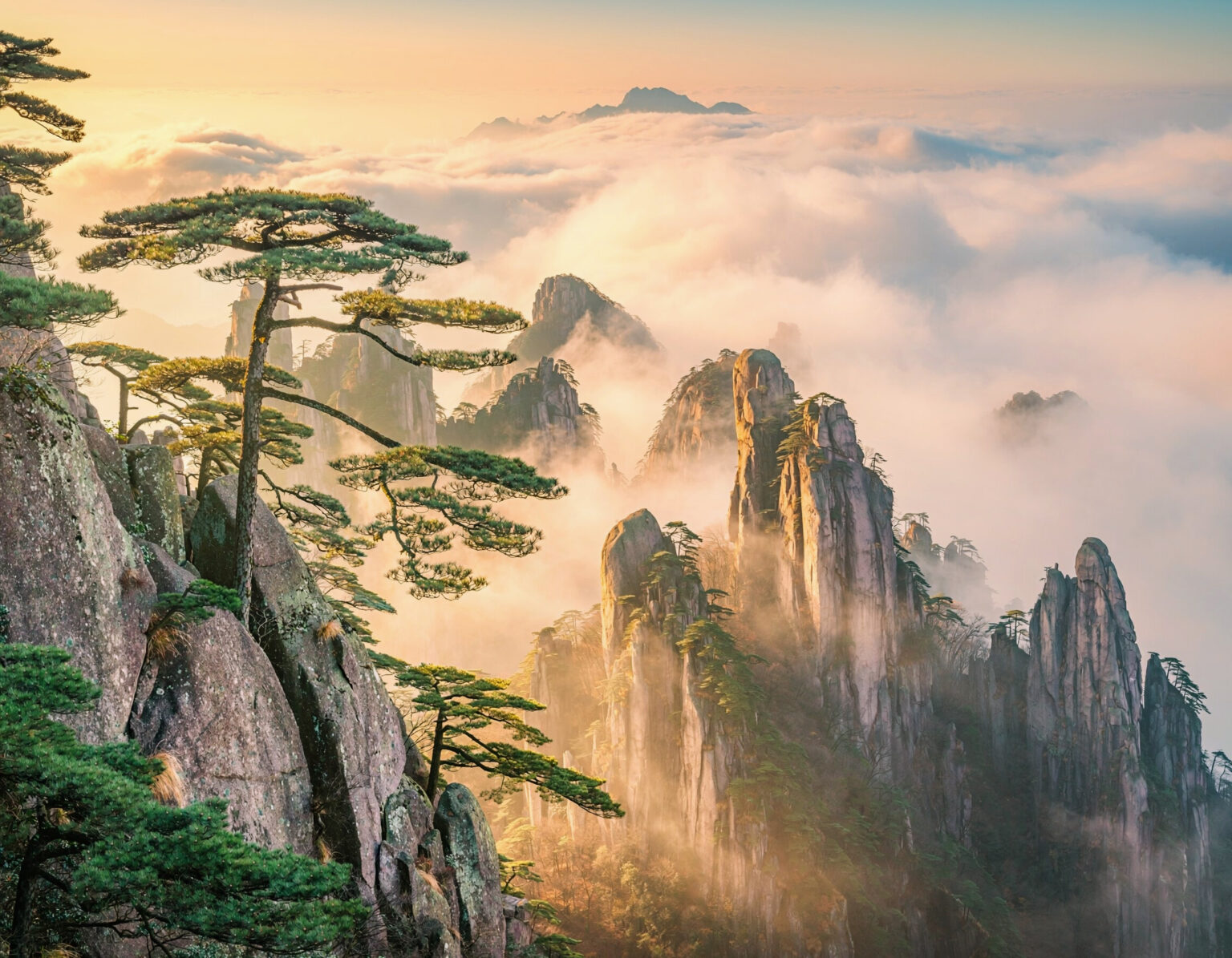
A pine tree reaches out from a granite ledge. Beyond it, mountain peaks appear through a break in the cloud. For a few moments, the scene has depth, separation, and just enough light. Then the mist moves, and the photograph changes.
This is the appeal of China’s Yellow Mountains for photographers. The landscape gives you the structure, but the weather keeps rearranging the picture.
Known as Huangshan, the Yellow Mountains are a mountain range in southern Anhui Province in eastern China. They are famous for steep granite peaks, unusually shaped rocks, old pines growing from unlikely places, and clouds that sometimes fill the valleys below. Their natural beauty and influence on Chinese art earned Huangshan UNESCO World Heritage status in 1990.
Huangshan is also one of the places we’re looking forward to sharing on our China photography workshop, planned for May 7–22, 2028. Our itinerary includes two nights on the mountain, giving us time to photograph through changing conditions and work with both early and late light.
For a location like this, time matters.

The name Yellow Mountains has its roots in Chinese legend. The mountains were renamed Huangshan in AD 747 in association with the Yellow Emperor, who, according to tradition, sought immortality here. That connection helped establish their place in Chinese cultural history.
For centuries, poets and painters have found inspiration among these peaks. Huangshan became an important subject in Chinese landscape painting, with artists interpreting its rocks, pines, and clouds through ink and brushwork. Looking at the landscape, it is easy to understand why.
There is a useful lesson for photographers in that artistic tradition: you don’t need to describe every detail to communicate a place.
A single pine against mist can carry a photograph. So can three ridgelines becoming progressively lighter in the distance. Empty space can give a tree room to breathe or emphasize how isolated a peak feels.
That is something I want us to explore in Huangshan—how to simplify a complicated landscape without losing its character.
The wider views will certainly get your attention. Granite towers rise above deep valleys, and the eye naturally follows the ridges into the distance. A wide-angle lens can help connect a nearby rock or tree with that larger setting.
But I would encourage you to spend time with a longer lens as well.
Look for a pine separated from the cliff behind it. Find a small group of peaks with a clear relationship between them. Watch for light catching one rock face while the surrounding mountains remain in shadow. Those smaller compositions can become some of the most personal photographs of the trip.
Huangshan also gives us a reason to slow down.
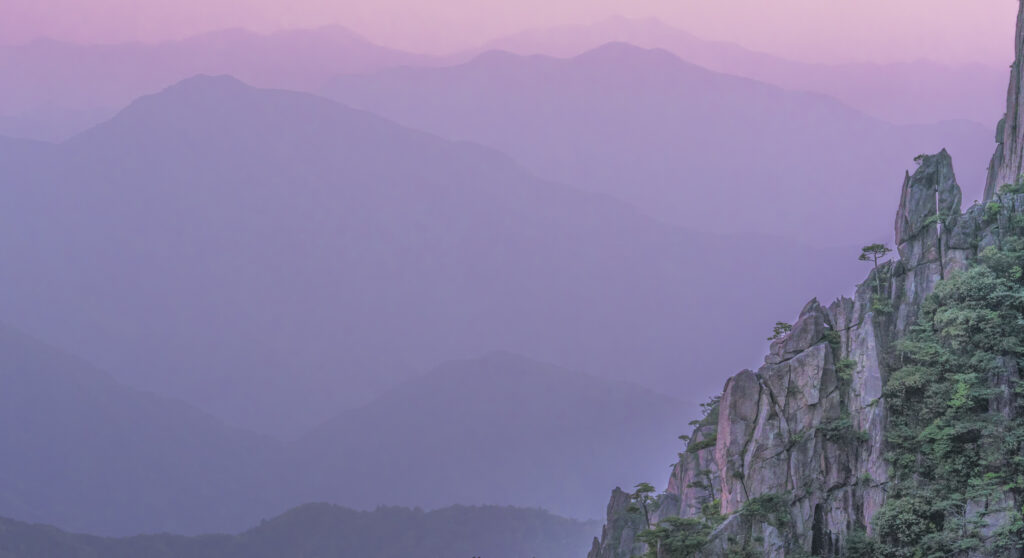
When clouds move through the mountains, a scene can reveal itself in stages. First, the outline of a tree. Then a ridge behind it. Finally, a distant peak that gives the photograph its depth.
Once you find a composition, it can be worth staying with it. Watch the background as carefully as the foreground. Be ready when the elements separate.
The famous “sea of clouds” is something we would love to experience, but it depends on the weather. Our photography will respond to the conditions we find. Clear mornings may bring defined ridgelines and directional light. Mist can simplify a busy background. Overcast conditions can draw our attention to texture, shape, and quieter details.
We’ll work on making deliberate choices: where to stand, what to include, how much depth of field we need, and when to release the shutter. If branches are moving in the wind, we’ll also need to balance aperture and ISO with a shutter speed that keeps them sharp.
A tripod helps, but it doesn’t persuade a pine tree to hold still.
Our planned stay at Huangshan Beihai Hotel puts us on the mountain for two nights. We’ll ascend by cable car, carry what we need for our stay, and leave our larger luggage below. The schedule includes sunset photography, a full day on the mountain, and another sunrise session before we descend.
Staying there gives us more opportunities to learn the landscape and revisit compositions. It also allows the photography to extend beyond a single brief stop at a viewpoint.
There is walking involved, including stone steps and changes in elevation. The cable car handles much of the ascent, but you should be comfortable carrying your camera equipment along mountain paths. Packing thoughtfully will make the experience more enjoyable.
Huangshan forms part of a broader journey that also includes Shanghai, Hongcun village, Xiapu’s coast, the Li River and Yangshuo, Xi’an’s Terracotta Warriors, and the Great Wall.
Across those locations, we’ll photograph different subjects while building the same habits: reading light, finding clear compositions, anticipating a moment, and giving a scene enough time.
The Yellow Mountains offer a chance to put those habits to work in a landscape that has held artists’ attention for centuries. I want you to experience that sense of discovery for yourself—to notice a pine, a passing cloud, or a line of distant peaks and recognize the photograph you want to make.
Join us on our May 2028 China photography workshop to photograph Huangshan and the landscapes, people, and history along our route.