
Photographing leopards on safari: Africa’s most elusive big cat
By Kevin Pepper |
Of all the big cats in Africa, the Leopard is the one that haunts photographers the longest. Not because they’re impossible to find but because they’re impossible to forget. You never just see a leopard. You glimpse one, coiled in a tree, ghosting through tall grass, eyes glowing just past sunset—and in that instant, the chase becomes personal.
After over a decade of offering safari photography tips, I can tell you that photographing leopards isn’t about chance. It’s about reading signs, understanding behavior, being ready with the correct settings, and staying calm when the moment appears. Here’s how I help my guests get meaningful images of Africa’s most enigmatic predators.

Know your subject: The life of a leopard
Solitary by nature
Leopards are solitary cats. You won’t find them in groups like lions or even pairs like cheetahs (except during mating or when a female has cubs). They creep, often unseen, and rely on stealth and surprise to survive.
They’re territorial and mostly nocturnal, though in areas with low human pressure—like South Luangwa, remote parts of the Serengeti, or the Sabi Sands—you’ll see them hunting, feeding, or even resting during daylight hours.
Leopards are masters of the ambush
Leopards are ambush predators. They rely on patience and positioning, not stamina. They stalk in near silence, using cover and terrain to get close before launching into a short, explosive burst of speed. Their kill is often dragged into a tree to protect it from hyenas or lions.
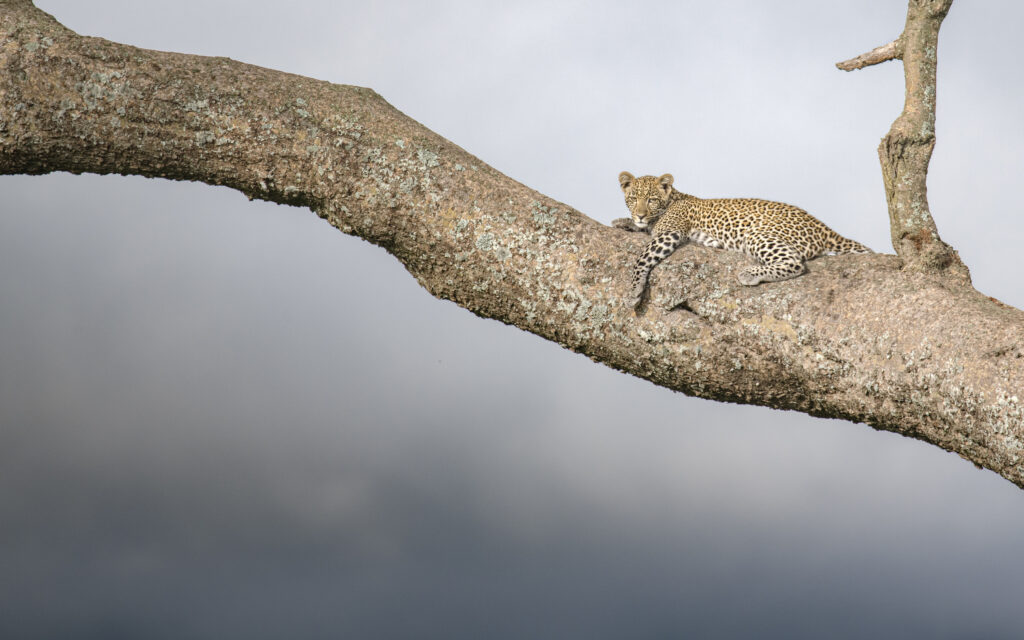
You’ll often find leopards lying on tree limbs, draped like shadows across acacia or sausage trees, tails flicking lazily in the wind. Or you’ll spot them at ground level, melting into the grass, watching, waiting.
Life of a mother leopard
Female leopards are fiercely protective. They hide their cubs in dense bush, high in trees, or rocky outcrops, moving them every few days to avoid detection. Photographing a leopard with cubs is rare and special. I’ve only had a few guests photograph those moments, and every time, it came from time spent quietly, patiently observing one female over multiple days.
A few years ago, we were in the Serengeti. We received reports of a mother with two cubs. We first saw her just after sunrise, low in the grass near a rocky outcrop in the central Serengeti. A young female leopard, alert but calm, scanning the horizon with that effortless grace leopards have. She wasn’t hunting. She wasn’t moving. She was watching. And something about her behavior made us stop.
For the next few hours, we sat with her as she dozed in the shade, occasionally lifting her head, ears twitching, eyes locked on something beyond our view. We knew what that meant—this was our Leopard, and she had cubs nearby. And if we were patient, we might get lucky.
Over the next two days, we returned to the same spot. She was always close—sometimes lounging on the rocks, sometimes draped across a low branch, sometimes just a flick of a tail in the grass. But no sign of the cubs.
We gave her space. Never pressured and never pushed. Just watched. Waited. Listened to the quiet hum of the bush and trusted her to reveal her secret when she was ready.

And then, on the third morning, just after first light, we saw movement in the fork of an acacia tree no more than 50 feet from the road. At first, it looked like nothing more than a tangle of shadow and bark. But then a paw stretched out, followed by a spotted belly, and a small, sleepy head popped up from the crook of the limb.
Two cubs. Perfectly camouflaged. Hidden in plain sight all along.
The mother was nowhere in view, but we knew she’d placed them there deliberately—safe from hyenas, off the ground, invisible to the untrained eye. We stayed quiet. No engine noise. No radio chatter. Just the click of shutters and the occasional sharp inhale every time one of the cubs yawned or peered down at us with wide, curious eyes.
It was one of those moments you don’t chase—you earn. A combination of timing, restraint, and just enough faith in the process to sit and let the story unfold.
That frame—two leopard cubs nestled in the crook of a tree at dawn—is still one of my favorite leopard images. Not because it’s dramatic. But it reminds me of what this kind of photography is really about.
Sometimes, the wild gives you a gift.
But only if you’re patient enough to wait for it.

The strategy: How to find and photograph a leopard while on safari
Let me be clear: you don’t chase leopards. You find tracks. You listen to the bush. You keep an eye on the trees. You follow alarm calls. And then, if you’re lucky, you get into position before the cat reveals itself.
Follow the clues
Start with tracks—especially early morning when they’re fresh. Look for drag marks, scratchings on tree trunks, and flattened grass near termite mounds or riverbeds. If you hear vervet monkeys or impalas barking alarm calls, pay attention. They’ve seen something you haven’t.
Birds, too, give it away. A flurry of activity in the treetops or sudden silence in the bush is often your first hint.
Be ready for leopards in trees
Leopards love trees. They use them to rest, eat, and observe. If you’re scanning a tree line, don’t just look at the trunk—look up. Scan every thick limb. Watch for dangling legs, the flick of a tail, or the curve of a spotted spine against the bark.
Stay quiet, stay still
Leopards hate noise. If you find one, cut the engine. No clicking lenses, no sudden movements. Let the leopard get comfortable with your presence. The more relaxed it becomes, the more natural your images will appear.
Think like a stalker
Leopards often circle before hunting. If a leopard starts moving through the grass with purpose, stay ahead of it—loop around at a respectful distance and let it come toward you. Don’t chase. Position. Predict. Wait.

The black leopard of Kenya: Photographing a living legend
No article on Leopards is complete without mentioning the Black Leopard. There’s the elusive leopard—and then there’s mythical. The black leopard, also known as the melanistic leopard, falls squarely into the latter category. For decades, these shadowy cats were the stuff of stories and blurred camera traps. But that all changed when one was photographed in daylight in Laikipia, Kenya—a sighting that shook the wildlife photography world and reignited global fascination with this rare phenomenon.
What is a black leopard?
Despite the name, black leopards aren’t a separate species. They’re African leopards (Panthera pardus pardus) with a genetic condition called melanism, which causes an overproduction of pigment. The result? A black coat that still shows faint rosettes in the right light. In essence, they are still patterned—but cloaked in shadow.
Melanistic leopards are rare everywhere, but in Africa, they’re exceptionally rare. For years, the only reliable photographic evidence came from camera traps—nocturnal glimpses in grainy black and white.
Until recently.
The sighting that changed everything
In 2019, British wildlife photographer Will Burrard-Lucas made headlines when he captured high-resolution images of a black leopard in Laikipia, Kenya. It was the first time a black leopard had been photographed in Africa in natural daylight in over a century.
Since then, the area—particularly the private conservancies near Loisaba and Laikipia Wilderness Camp—has become a magnet for photographers hoping to catch a glimpse of this near-mythic creature. But make no mistake—sightings are still rare. The black leopard’s territory spans dense bush and rocky terrain, and it behaves like most leopards: silently, and mostly by night.
Photographing a black leopard
If you’re serious about trying to photograph one, it’s not a matter of luck—it’s a matter of strategy, time, and patience. You’ll need:
- Time on the ground—at least several days in the area, with local guides who know the leopard’s territory and behavior.
- Night-capable gear—fast lenses and good high-ISO performance. Infrared or motion-triggered cameras may be helpful, but daytime sightings are also possible under the right conditions.
- A willingness to fail—even seasoned professionals spend days without a sighting.
And we can speak from experience, when you do see one—and I hope you do—it’s a moment unlike any other. A ripple of shadow in the grass. Gold eyes in a black mask. It’s not just a photo. It’s history. You can read about our safari with the Black Leopard. Donna Passero wrote an article about that safari. You can see that article on the Black Leopard here.
Best Places in Africa to Photograph Leopards
Leopards are widespread, but some locations stand out for reliable sightings, relaxed animals, and great photographic conditions:
1. Sabi Sands, South Africa
Probably the best place in Africa to photograph leopards. They’re well-habituated, frequently seen during the day, and the guides are exceptional at tracking them.
2. South Luangwa, Zambia
The “Valley of the Leopard.” Excellent for night drives and low-light photography. The leopards here are active, visible, and the variety of backdrops is stunning—trees, rocky escarpments, and riverbanks.
3. Serengeti / Ndutu, Tanzania
Leopards are more elusive here, but the reward is high. They’re often seen draped over limbs in acacia trees or hiding in kopjes, especially in the Ndutu woodlands during calving season.
4. Okavango Delta, Botswana
Water, reeds, forest, and floodplains make for dramatic leopard shots. The cats here are secretive but beautifully photogenic when found.
5. Lower Zambezi, Zambia
With riverine forests and dramatic light reflecting off the Zambezi, this region offers some of the most atmospheric leopard scenes I’ve photographed.
Camera Gear and Settings for Photographing Leopards
Leopard photography is often about light and patience. Your gear needs to be versatile and responsive.
Recommended Gear:
- Main Lens: 100–400mm or 200–600mm for versatility when they’re in trees or on the move.
- Second Lens: 70–200mm or a fast prime (like a 300mm f/2.8) for lower light and portraits.
- Wide-Angle: 24–70mm if the cat gets close or you want to capture the scene.
Settings:
- Shutter Speed:
- 1/500s–1/800s for a resting leopard
- 1/1600s+ for movement or hunting sequences
- Aperture:
- f/4–f/5.6 for portraits and shallow depth
- f/8 when photographing a leopard and cub or in deep foliage for more depth
- ISO:
- Start at ISO 400 in daylight, but be ready to push to 3200 or more in shade or at dusk
- Focus Mode:
- Single point for precision
- Eye-detect if your camera supports it—especially helpful with backlit cats in trees
- Drive Mode:
- Medium burst. A flick of the tail or glance over the shoulder makes all the difference.
Pro Tips:
- Use spot metering when backlit to preserve details in their face. Meter for the cat, and remember to use exposure compensation. Worry about retaining the details in the cat, not in the sky.
- If they’re in a tree, compose wide first—then go tighter. Don’t forget the environment.
- Get low when possible. Eye-level leopard shots are gold.
- Wait for the look—that head-turn, that gaze through the grass. Don’t rush it.

Final Thought
Leopards are quiet, fluid, and deeply aware of their surroundings. If lions are rulers and cheetahs are racers, leopards are ghosts. And photographing them is about patience, intuition, and being in the right place at the right still moment.
The best leopard shots I’ve ever taken didn’t come from chasing them. They came from understanding them.
So slow down. Track the signs. Let them come to you. And when they do, raise your camera with reverence. You’ve just been invited into the secret world of Africa’s most elusive cat. And we would be honored to take you on one of our African Photo Safaris.
Read Other Species Spotlight articles
If you’re as passionate about wildlife as we are, take a moment to explore our Species Spotlight series. Each article dives into the fascinating lives of the animals and birds we love to photograph on our workshops—whether it’s a puffin perched on a cliff in Newfoundland, a leopard draped across a tree in Tanzania, or an Adelie penguin waddling through the snow in Antarctica. It’s a growing library of stories, facts, and inspiration for anyone who dreams of capturing the wild through their lens. Come see the world the way we do—one species at a time.


