Species Spotlight: Gartered Trogon
By Kevin Lisota |
Introduction of the Species
The Gartered Trogon is one of those birds that rewards photographers who slow down and really look. It does not crash into a scene like a macaw or shout for attention like a toucan. Instead, it sits with quiet confidence, showing off rich color, clean lines, and that classic trogon shape that always seems a little too elegant for the branch it is sitting on. In Costa Rica, it is one of those species that makes you appreciate just how deep the country’s bird photography can go.
Physical Description
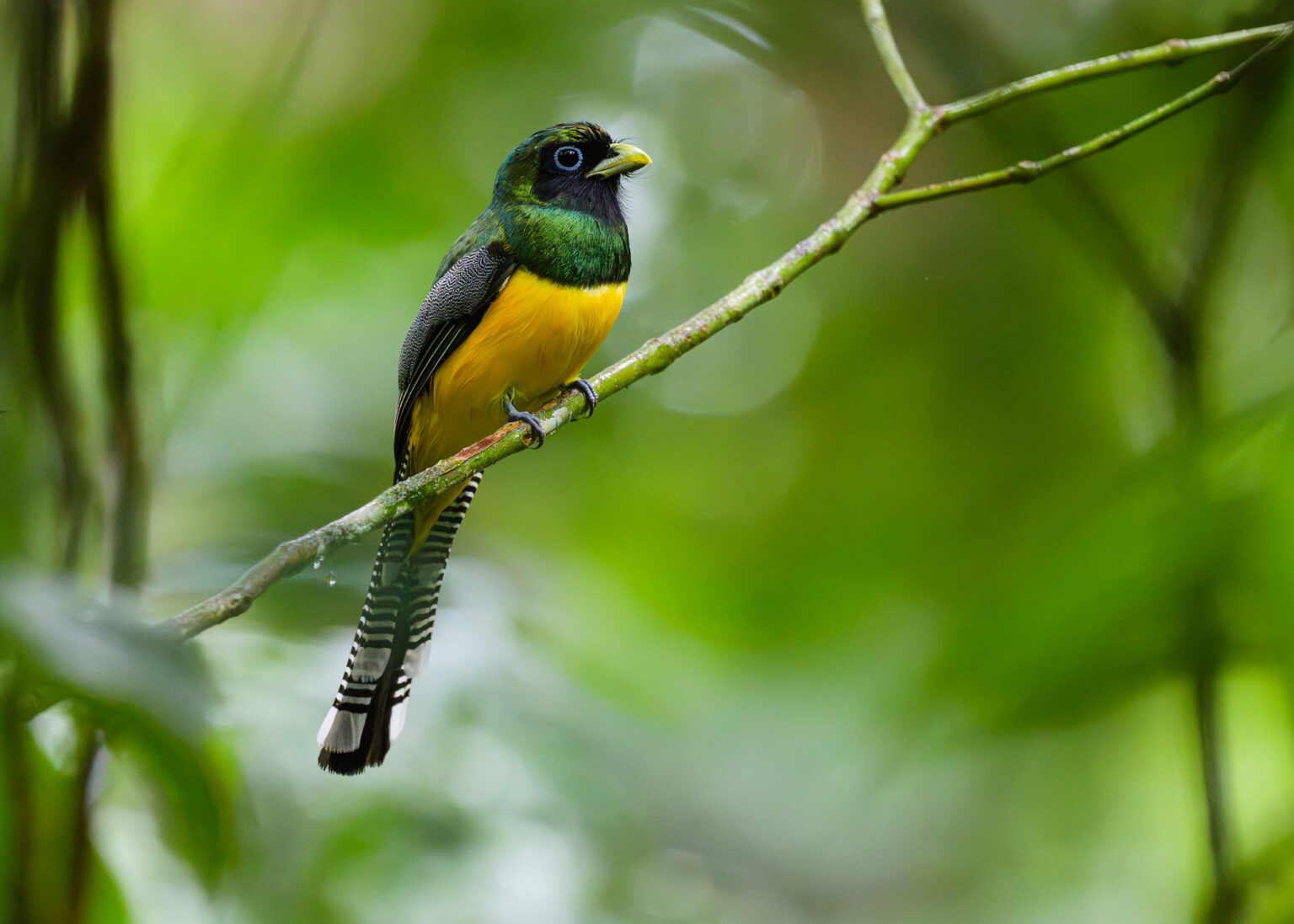
The Gartered Trogon is a medium-sized trogon with a sturdy body, a fairly large head, and a straight, broad bill. Males are especially striking, with a yellow belly, green to green-blue upperparts depending on light, a dark face, and finely patterned black-and-white wings. Females are more subdued, with grayer or browner tones replacing much of the male’s brighter upperpart color, but they are still handsome birds with the same elegant posture and long-tailed balance that make trogons so photogenic.
Native Habitat
This species is most often found in semi-open landscapes, forest edge, clearings, gallery forest, secondary forest, and shaded coffee or cacao plantations. In Central America it reaches up to about 1,400 meters, though it is generally more common in the lowlands. That makes it a rewarding subject for photographers working not just in dense rainforest, but also in the transitional habitats where light, perch options, and cleaner backgrounds often come together nicely.
Where They Are Found in Central and South America
The Gartered Trogon ranges through parts of Central America and northwestern South America. The subspecies relevant to Costa Rica, Trogon caligatus concinnus, occurs from Costa Rica through most of Panama into western Colombia, and also separately from western Ecuador into northwestern Peru. Costa Rica is therefore well within one of the species’ core Central American strongholds.
Behavior in the Wild
Gartered Trogons are often seen perched quietly for long stretches, scanning their surroundings before making a short movement to feed. That calm, patient style is part of what makes them such appealing photographic subjects. They are year-round residents in at least part of their range, and while movement patterns elsewhere are not fully clear, they are not known as long-distance migrants. Their song is described as a long series of rapid, hollow, downslurred notes, and once you learn the sound, it becomes much easier to pick one out of a busy tropical forest edge.
Food and Eating Habits
The Gartered Trogon usually feeds by hovering or making short sallies to pluck fruit and invertebrates from vegetation. Compared with many other trogons, it appears to take a larger proportion of fruit, though insects and other invertebrates are still an important part of the diet. It sometimes joins mixed-species foraging flocks, which is one more reason bird photographers in Costa Rica learn to pay attention when the forest suddenly gets active.
Nesting and Breeding
In Costa Rica, the breeding season has been reported from February through June. Gartered Trogons nest in cavities, often using arboreal wasp, ant, or termite nests, or holes in rotten trees. Typical clutch size is two or three eggs. That nesting behavior is one of the more interesting things about trogons in general. They are elegant birds, but when it comes to nest choice, they are perfectly happy to work with a decaying stump or an old insect structure if it gets the job done.
Why Photographers Love Them
Photographers love the Gartered Trogon because it combines beauty with just enough restraint. It is colorful, but not gaudy. It is tropical, but not chaotic. It often gives you time to compose, think about the background, and wait for a subtle head turn or a better angle. That makes it a wonderful species for photographers who want to create more refined bird portraits rather than simply chasing color. In Costa Rica, it is one of those birds that quietly lifts the quality of a portfolio.
Join Us in Costa Rica
Birds like the Gartered Trogon are why Costa Rica keeps photographers coming back. It is not just the color. It is the elegance, the habitat, and the chance to make images that feel rich and tropical without looking forced. Join our Costa Rica photo workshop and let us help you create the kind of bird images you will actually be proud to show.