Species Spotlight: Wildebeest
By Kevin Pepper |
Introduction of the Wildebeest
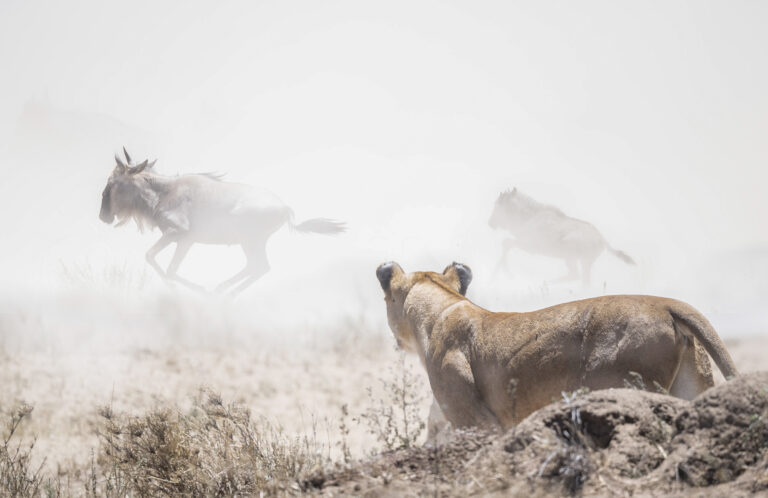
Wildebeest aren’t graceful. They’re not glamorous. But they are one of the most compelling wildlife subjects in Africa—thundering hooves, dust clouds, raw survival, and the timeless rhythm of migration. Photographing them isn’t just about capturing a species—it’s about capturing motion, tension, and the pulse of the savanna.
Physical Description
Wildebeest, also known as gnus, are large antelope with a unique, almost prehistoric look. They have a heavy front end, broad shoulders, high withers, and a sloping back. Both males and females have curved horns. Their shaggy manes, beard-like throat fringe, and long tails complete the look. Their coloring varies by species, ranging from grayish brown to bluish-gray to rich chocolate brown.
Physical Variations Among the Species
There are two main species:
- Blue Wildebeest (Connochaetes taurinus): Found in East and Southern Africa. Recognizable by its bluish sheen and darker facial stripes.
- Black Wildebeest (Connochaetes gnou): Native to southern Africa, darker in color, with a white tail and forward-curving horns.
Photographers are most familiar with the Blue Wildebeest, especially during the Great Migration, but the Black Wildebeest is just as striking—especially in open grassland light.
Native Habitat Around the World
Wildebeest are native to Africa and are found in:
- Tanzania
- Kenya
- Botswana
- Namibia
- South Africa
- Zambia
- Zimbabwe
- Mozambique
They live in open savannas, short-grass plains, and lightly wooded areas. Blue Wildebeest thrive in the Serengeti ecosystem and Okavango Delta, while Black Wildebeest prefer highveld grasslands of South Africa and Lesotho.

Who Preys on the Wildebeest
Wildebeest are the main course on the African savanna buffet. They are hunted by lions, hyenas, leopards, cheetahs, crocodiles, wild dogs, and even opportunistic jackals. Their calves are especially vulnerable. River crossings during the migration offer some of the most dramatic predator-prey encounters you’ll ever witness—or photograph.
Food/Eating Habits of the Wildebeest
Wildebeest are grazers, feeding almost exclusively on short grasses. They are water-dependent and typically stay within reach of fresh water, which shapes their daily and seasonal movement. Their grazing helps maintain grassland ecosystems, often triggering movement in other herbivores like zebras and gazelles.
Known Lifespan
In the wild, wildebeest live 15–20 years. Calves can stand within minutes of birth—an evolutionary necessity in a world full of predators. Those early days, especially during calving season, are a gold mine for photographers.
What Is the Great Migration?
The Great Migration is one of the greatest wildlife spectacles on Earth—and wildebeest are at its core. Each year, over 1.5 million Blue Wildebeest, along with hundreds of thousands of zebras and gazelles, travel in a circular route through Tanzania and Kenya in search of fresh grazing and water.
- The cycle begins in Tanzania’s southern Serengeti, where calving happens around January to March.
- By May to June, the herds move north through the Western Corridor.
- July to October brings the famous Mara River crossings into Kenya’s Maasai Mara—a chaotic, high-drama scene that’s a highlight of any wildlife photographer’s career.
- As the rains return south, the herds reverse course and return to the Serengeti by November.
It’s not a single event—it’s a continuous, circular movement dictated by rainfall and grass growth. And it’s breathtaking.
Join Us on a Photo Safari In Africa
We photograph wildebeest across East and West Africa, but nothing compares to the Great Migration in Tanzania and Kenya. Whether you’re shooting wide environmental scenes of endless herds or waiting at a riverbank to catch the moment a croc lunges from the water, we’ll be right there with you—coaching, guiding, and helping you capture the story. See our African Safaris here.
From dust to drama, motion to majesty, the wildebeest is more than a subject. It’s a symbol of wild Africa.
Read Other Species Spotlight articles
If you’re as passionate about wildlife as we are, take a moment to explore our Species Spotlight series. Each article dives into the fascinating lives of the animals and birds we love to photograph on our workshops—whether it’s a puffin perched on a cliff in Newfoundland, a leopard draped across a tree in Tanzania, or an Adelie penguin waddling through the snow in Antarctica. It’s a growing library of stories, facts, and inspiration for anyone who dreams of capturing the wild through their lens. Come see the world the way we do—one species at a time.