Witnessing the wild: The Great Migration in East Africa
By Kevin Pepper |
For over a decade, I’ve returned to witness Earth’s most incredible wildlife show: the Great Migration in Tanzania. It’s not just a movement of animals—it’s a movement of life itself, guided by ancient instincts, seasonal rains, and the never-ending search for fresh grass and survival. For photographers, it’s a gift that keeps giving. Each location, each season, and each year delivers something new.
What is the Great Migration in Tanzania and Kenya?
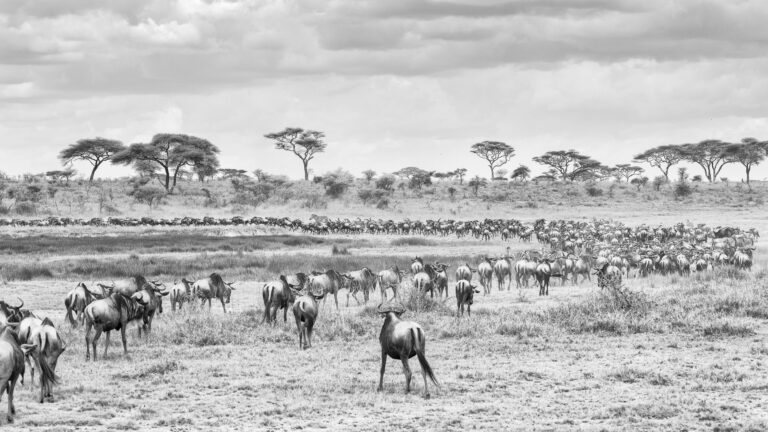
The Great Migration is the annual circular journey of millions of wildebeest, zebras, and gazelles across the Serengeti in Tanzania and the Maasai Mara in Kenya. It’s not a one-time event—it’s a constant, clockwise rotation fueled by weather, water, and survival. From calving season in the southern Serengeti to dramatic river crossings in the north, the journey never truly ends.
For those chasing images that speak to the soul, it’s an ever-changing canvas of motion, tension, and raw life.

Which animals migrate?
The stars of the show are:
Wildebeest (approx. 1.5–1.7 million) – the migration engine. Their thundering hooves and relentless march to find the rains define the rhythm of the plains.
Zebras (about 200,000) – forming tight bonds and providing early warning systems. Their sharp eyesight and nervous temperament often alert the others to danger first.
Thomson’s and Grant’s Gazelles (about 500,000) – delicate, agile, and often overlooked, but in the right light, they’re poetry in motion.
But it’s not just about the herbivores.
Lions, cheetahs, hyenas, leopards, crocodiles, jackals, and vultures follow the migration like shadows. For them, this annual journey is a feast, a hunt, and a necessary chaos. And for us, behind the lens, it’s where the actual storytelling lives.
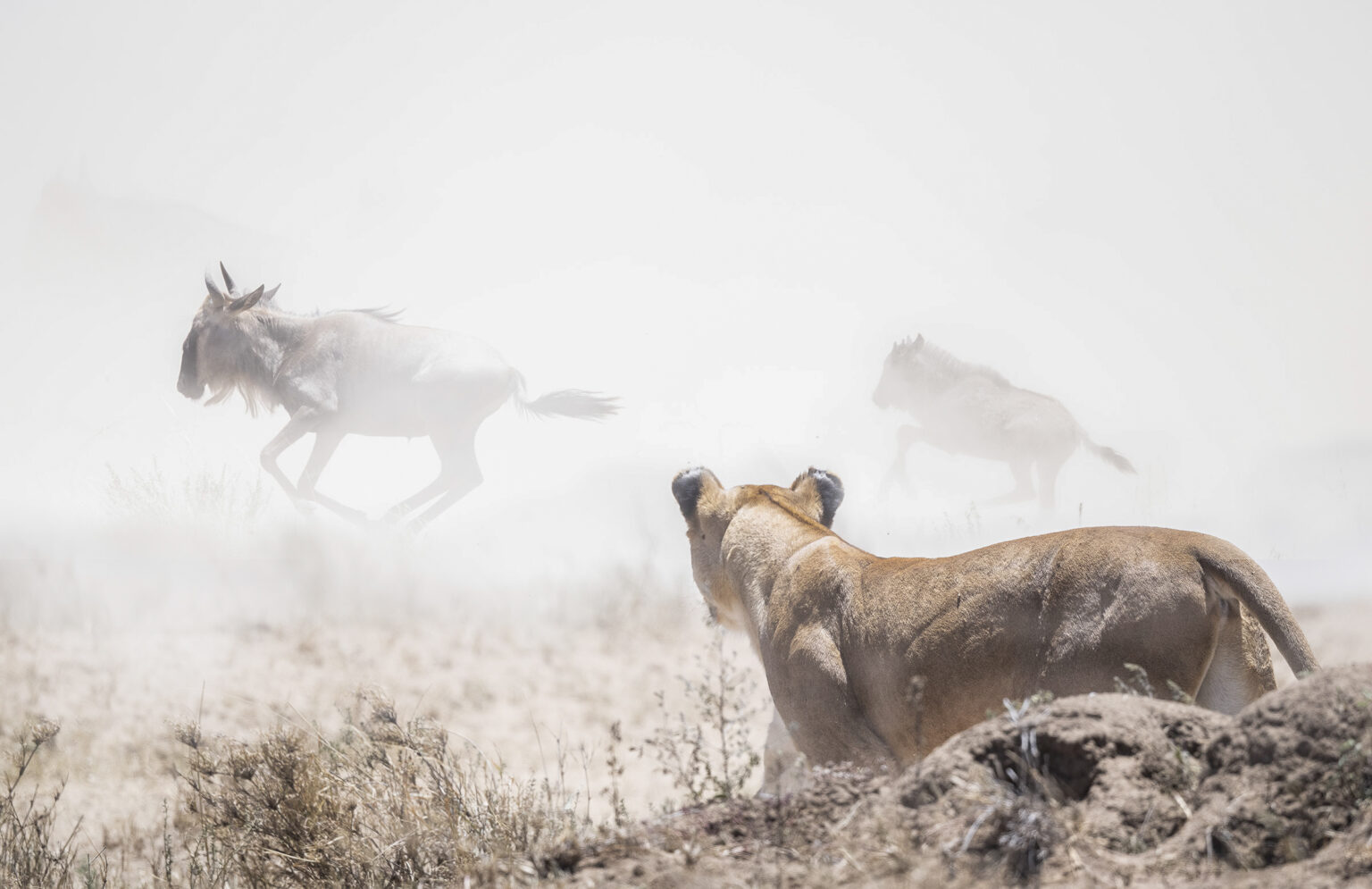
In the southern Serengeti, lions prowl the edges of herds during calving season, watching for weak or isolated calves. One morning in Ndutu, I watched a lioness stalk a newborn wildebeest just minutes after it stood. The kill happened fast. Brutal, yes—but that’s the reality of these plains. The image told the whole story: life, death, and instinct, all in a single shutter click.
Cheetahs use the open terrain to their advantage—lightning-fast bursts of speed that can outmatch anything on four legs. I’ve watched them explode from tall grass, targeting gazelle fawns with surgical precision. Their success rate is lower than you’d think, but when it happens, it’s over in seconds.
Hyenas, often misunderstood, are relentless and strategic. They hunt more than they scavenge, especially during the migration. I once saw a clan of over a dozen take down a full-grown wildebeest—coordinated, efficient, and loud. The calls echo through the night long after the kill.
Then there are the crocodiles—the river monsters of the Mara and Grumeti. They are ancient and patient. They wait for the crossings, sometimes for weeks, conserving energy until that one moment. When it happens, it’s violent. A wildebeest pulled under, a zebra fighting for traction, the splash, the struggle, the silence that follows. It’s not for the faint-hearted, but it’s visceral and unforgettable as a photographer.
Vultures and marabou storks complete the cycle, brutally descending on the aftermath. You can photograph the entire story—from the hunt to the aftermath—within a single day.
The predators add drama. And the drama adds depth to your frame.
Every chase, every kill, every moment of tension reminds you—you’re not just photographing wildlife. You’re photographing the very core of nature’s design.
How many animals migrate on the Great Migration in Tanzania?
At its peak, over two million animals are on the move. I remember flying low over the southern Serengeti once, watching as the plains seemed to shimmer with the movement of wildebeest—so many that the land looked like it was breathing. You don’t count them. You feel them.

Why do these animals migrate together?
It’s a symphony of survival.
Zebras, wildebeest, and gazelles don’t migrate together by accident. Each species fills a specific role in a natural system that’s been fine-tuned over millennia. Zebras lead the way, often arriving first. Their strong teeth can handle the coarse, dry top layer of grass. As they graze, they clear the way—exposing the tender green shoots that the wildebeest prefer.
While not the sharpest in the herd, wildebeest have one of the best senses of smell in the savannah. They can sniff out rain and fresh grass from dozens of kilometers away, guiding the direction of the herds. They make up for what they lack in vision in this uncanny ability to detect weather patterns and moisture.
Zebras, on the other hand, have exceptional eyesight. Their vision is sharper and broader, giving them the edge in spotting distant predators. Together, these two species form a natural alliance—zebras as the early warning system, wildebeest as the trackers of food and water.
Then come the gazelles, often bringing up the rear. Small and fast, they thrive on the shortest grass, often left untouched by the larger grazers. Their agility helps them escape predators, and their presence rounds out the ecosystem that follows this migration.
Beyond feeding strategies, safety in numbers is another reason they stick together. When millions of hooves move as one, the odds of survival increase for the individual. A lone wildebeest is an easy target. The odds shift in a mass of thousands—at least for a while.
And let’s not forget the predators—lions slinking through the grass, cheetahs perched on termite mounds, crocodiles lurking in rivers. They’re part of the reason this alliance works. Herding together spreads the risk. One may fall, but the majority survive.
This collective migration isn’t just about following the rain—it’s about cooperation, instinct, and the kind of shared wisdom only nature can orchestrate.
What causes the Great Migration (and why does it continue)?
Rain. Or, more accurately, its absence. The migration follows the rains and the promise of green grass. It’s not about direction or destination—it’s about survival. Every step, every crossing, every calf born on the plains is dictated by the pulse of weather.
Despite climate shifts and human encroachment, the migration continues. It’s one of the last great wild rhythms left on Earth.
How long has the Great Migration in Tanzania been happening?
The herds have moved as long as there’s been rain in the Serengeti. Scientists believe this pattern has likely existed for hundreds of thousands of years, if not more. Fossil records and indigenous histories both speak of mass animal movements across East Africa.
I’ve often stood with local Maasai guides who talk about the migration not as an event but as a constant—something older than memory, part of the land itself.
The photographer’s guide to the Great Migration in Tanzania
Southern Serengeti – calving season (late January to March)
This is where it all begins. In the short-grass plains near Ndutu, wildebeest give birth to around 500,000 calves in just a few weeks. It’s quiet in the way only Africa can be—until the first yelp of a newborn fills the air, and then the predators take notice.
As a photographer, it’s a masterclass in storytelling. I’ve captured a lioness stalking the perimeter of a herd, eyes locked on a wobbly-legged calf not ten minutes old. In another frame, a mother wildebeest stood defiant between her baby and a jackal. It’s raw. It’s tender. And it’s where life and death hang in the same breath of wind.
Best photo: Wide angles of massive herds with looming skies, intimate moments of new life, and predator-prey tension in soft light.
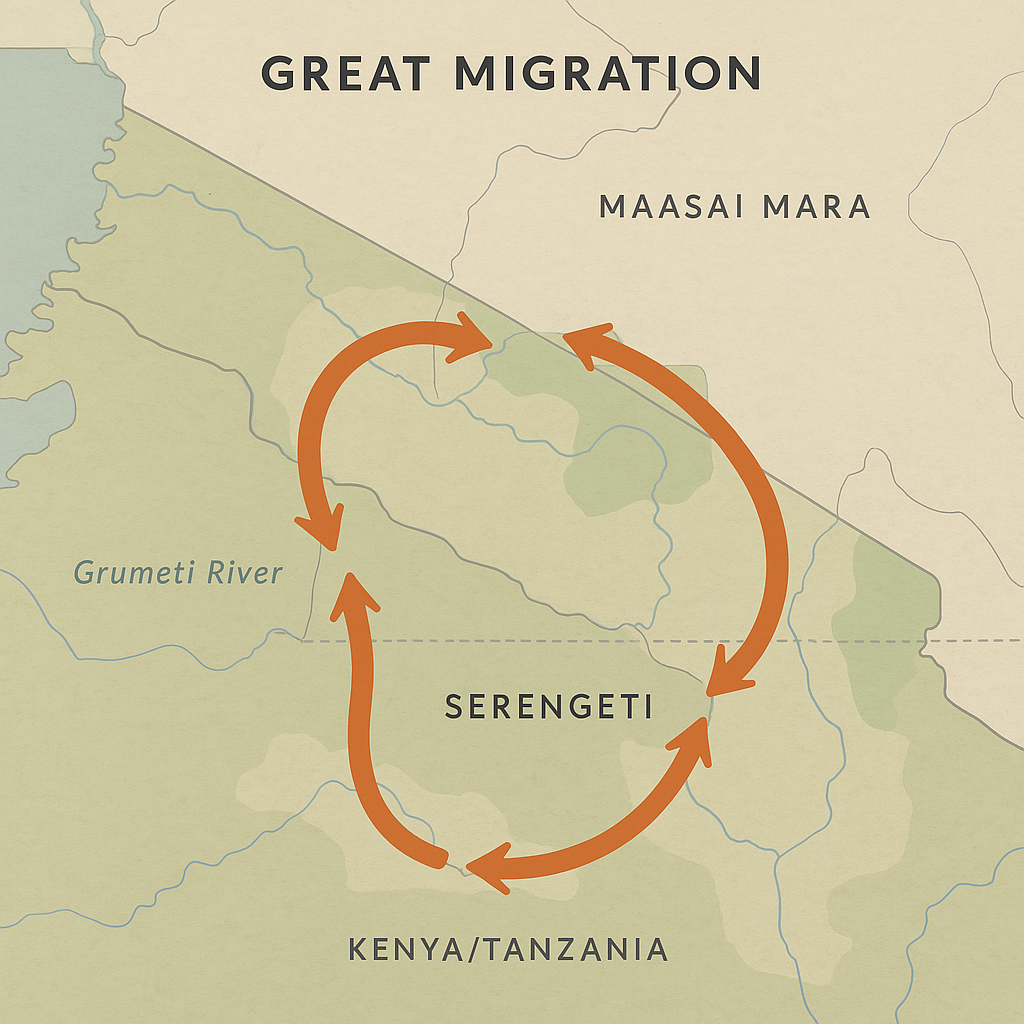
Western Corridor – Grumeti River crossings (May to early July)
As the rains move west, the herds funnel toward the Grumeti River. It’s not as famous as the Mara, but the crossings here are no less dramatic. Fewer vehicles, richer colors, and crocodiles the size of safari vehicles waiting in ambush.
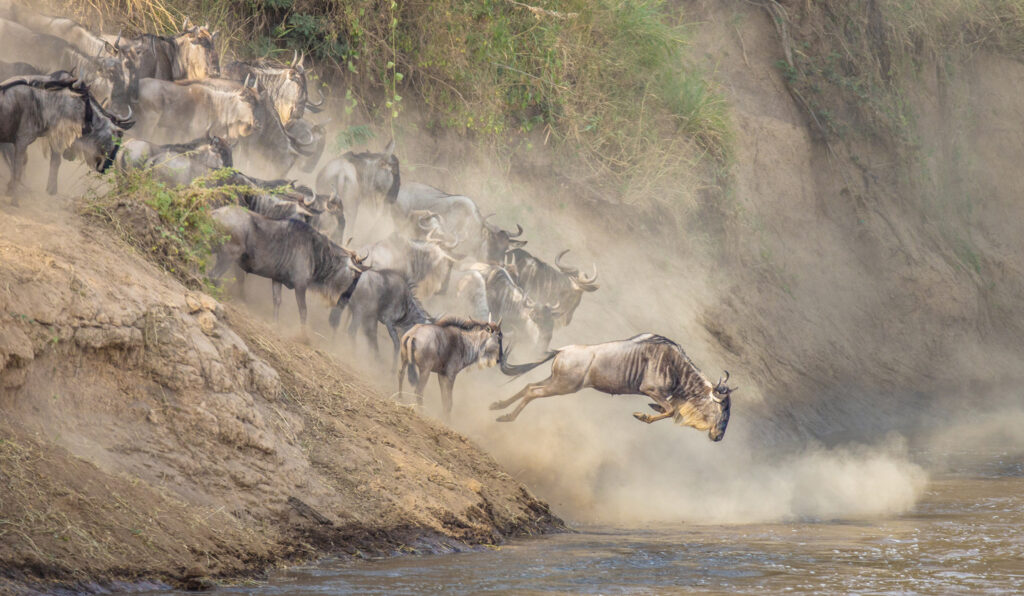
One June morning, we set up early. Mist hovered over the river—then the sound—a deep grunt, then another. The first wildebeest dipped a hoof into the water, and chaos followed. We caught them mid-leap, hooves suspended, droplets flying, crocs just beneath the surface. It’s a scene that feels like it belongs in prehistory.
Best photos: Mid-action jumps, riverbank dust, crocodile ambushes, and low-light storytelling.
Northern Serengeti & Maasai Mara – Mara River Crossings (Late July to October)
This is the migration at its most iconic—herds bottleneck at the riverbanks, hesitant and nervous. One leap triggers thousands. The crossings are chaotic, thrilling, and haunting.
In 2017, I spent four consecutive mornings waiting for the perfect crossing. On day five, we got it—a crossing that lasted nearly an hour. I still remember the dust, the deafening sound of hooves, and the crocodile that snapped at a zebra mid-current—unsuccessfully. It was pure theater.
Best photos: Telephoto action from across the river, dust and chaos, and intimate frames of fear and flight.

Final thoughts on the Great Migration in Tanzania as a Reason to go on a Photo Safari
The Great Migration isn’t a checklist item—it’s a life experience. As a photographer, it’s a reminder of what wild truly means. It challenges your timing, your vision, and your ability to react. I return as much as I can. I find something new in the familiar. It’s a different light, a different drama, and a different story worth telling.
If you plan to photograph the Great Migration, go with people who know the terrain, understand the rhythm of the animals, and can get you in position before the magic begins. Check out our Photography Safaris in Tanzania.
And… Always bring extra memory cards. Trust me on that.