Spirit Bear vs. Black Bear: The Story Behind One of the Great Bear Rainforest’s Most Remarkable Animals
By Kevin Pepper |
There are some wildlife encounters you enjoy in the moment.
And there are others that stay with you.
The spirit bear belongs in that second category.
To see one in the Great Bear Rainforest is not just to see a rare animal. It feels like witnessing something older than the moment itself. White fur moving through dark timber. A pale figure along a salmon stream. A bear that seems to appear out of the moss, the mist, and the silence as if it had always been there, waiting for the forest to decide you were ready to notice.
It is the kind of sighting photographers dream about. Not because it is rare, though it certainly is. Not only because it is beautiful, though that goes without saying. It stays with you because it feels meaningful.
And yet, for all the mystery that surrounds them, spirit bears are often misunderstood.
Many people assume they are a different species from black bears. They are not.
A Spirit bear is a Black bear.
But like many of the best stories in the natural world, the truth is both simpler and more fascinating than it first appears.
The Indigenous story behind the spirit bear
Long before science explained the white coat, the Kitasoo/Xai’xais had their own explanation.
In their oral history, Raven made one in ten black bears white as a reminder of the time when this coast was covered in ice and snow. The white bear became a living memory of that ancient world and a symbol of gratitude for the rich land that followed.
That story matters.
Because in the Great Bear Rainforest, the spirit bear is not simply rare wildlife. It is sacred. It carries meaning tied to memory, stewardship, and the relationship between people and place. For the Kitasoo/Xai’xais, this is not just a bear with unusual fur. It is part of the cultural and spiritual life of the coast.
That changes the way you think about it.
For some travelers, a Spirit bear is a bucket-list sighting. For the people whose history is rooted in this landscape, it is part of something much deeper. When people speak about the loss of the Spirit bear, they are not just talking about one remarkable animal disappearing. They are talking about the unraveling of a place, a story, and a balance that has existed for generations.

First things first: a Spirit bear is a Black bear
This is the part that surprises most people.
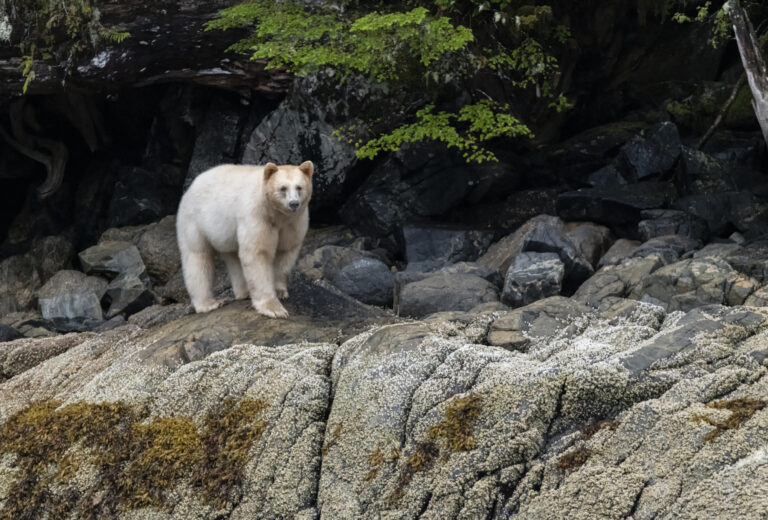
The Spirit bear is not a separate species. It is a rare white-coated form of the American Black bear found on the north and central coast of British Columbia. You may also hear the term Kermode bear, but when most people say spirit bear, they are referring to the white-coated individuals.
In simple terms, every Spirit bear is a Black bear, but not every Black bear is a Spirit bear.
That distinction matters, especially if you are trying to understand why these bears are so special.
The visual differences
The obvious difference is the coat.
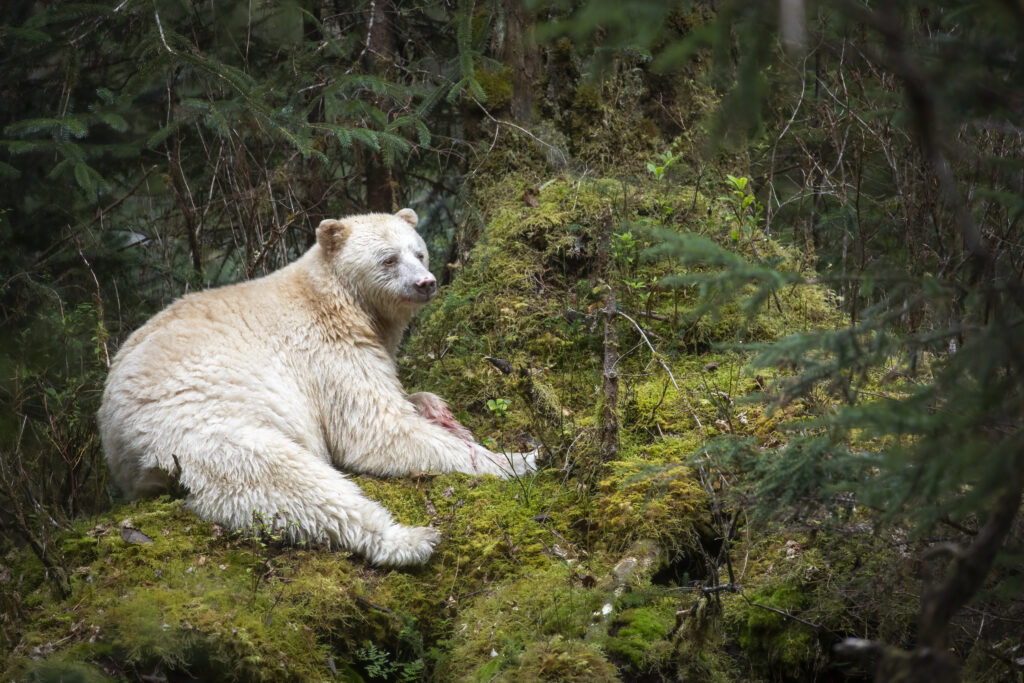
A Black bear in the Great Bear Rainforest is typically black or very dark brown. A Spirit bear has fur that ranges from creamy white to pale blond. In the filtered light of the rainforest, the contrast is striking. One disappears into the shadows. The other seems to gather the light.
For photographers, that contrast is part of what makes the experience so unforgettable. The dark greens of moss and cedar. The silver of the river. The pale coat against all that depth and texture. It is one of those scenes that feels almost too perfect to be real.
But there is an important point here.
Spirit bears are not albino.
They still have dark noses, pigmented skin, and usually brown eyes. Their color is not the result of albinism. They are black bears with a rare coat-color trait.
In body shape, size, claws, ears, and behavior, they are black bears through and through. They move through the same estuaries. They feed on the same salmon. They walk the same shorelines and forest trails. If you set aside the fur color, you are looking at the same animal.
The genetic difference
The white coat comes down to genetics.
Researchers have linked the color to a rare recessive variation in a gene associated with pigmentation. For a bear to appear white, it must inherit that variation from both parents. A bear that inherits only one copy will still look black, but it can carry the trait and pass it on.
That means two Black bears can produce a white cub.
And that is one of the things that makes this story so interesting. A Black bear that looks completely ordinary may still carry the spirit bear gene. So the future of Spirit bears depends not only on the white bears people hope to see, but also on the larger Black bear population that quietly carries the same lineage forward.
That is an important reminder that conservation is rarely about protecting only the obvious star of the show. Sometimes the full story is carried by what you do not immediately see.
Where can you find them
Black bears are found throughout the Great Bear Rainforest and across much of coastal British Columbia. In this landscape they use estuaries, beaches, berry patches, forest edges, and salmon streams. They are common compared with spirit bears, and if you spend time on the coast in the right season, your odds of seeing a Black bear are good.
Spirit bears are another story.
They are found only in a relatively small part of coastal British Columbia, especially within the Great Bear Rainforest on the north and central coast. Some of the best-known areas associated with them include Princess Royal Island, Gribbell Island, and nearby mainland watersheds.
That narrow range is part of what makes them so special.
You do not casually stumble into spirit bear country the way you might spot a black bear from the roadside elsewhere in North America. To see one, you need to be in a very particular place, in the right season, with the right conditions, and a little bit of luck from the rainforest itself.
As usual, nature does not hand out its best gifts too easily.
Why the Spirit bear matters
Yes, it matters because the animal is rare.
Yes, it matters because it is beautiful.
But the deeper reason it matters is because of what it represents.
The spirit bear is tied to healthy salmon runs, intact habitat, old-growth rainforest, and the stewardship that has protected this coastline for generations. When people fight to protect the Spirit bear, they are also fighting for cedar forests, estuaries, wolves, whales, and all the life that depends on this coast remaining wild.
That is the thing worth remembering.
The Great Bear Rainforest is not extraordinary because Spirit bears live there.
Spirit bears are extraordinary because they remind us how extraordinary the rainforest still is.

So what is the difference between a Spirit bear and a Black bear?
They are the same species.
The visual difference is coat color.
The genetic difference is a rare recessive trait tied to pigmentation.
Geographically, Spirit bears are found only in a small part of coastal British Columbia, while Black bears are much more widespread.
But emotionally, the difference feels larger.
A Black bear feels like the rainforest.
A Spirit bear feels like one of its oldest memories.
Join Us in the Great Bear Rainforest
There are wild places that impress you.
And then there are wild places that settle into you a little deeper.
The Great Bear Rainforest is one of those places.
This is a world of misty inlets, salmon-rich rivers, ancient cedars, and quiet shorelines where every bend seems to hold the possibility of something remarkable. It is a place that asks you to slow down. To watch more carefully. To listen more closely. To trade noise for patience.
And for photographers, that is part of the magic.
Yes, the Spirit bear is the dream. There is no point pretending otherwise. The idea of seeing one step from the shadows into the soft light of a coastal river is enough to make any photographer pay closer attention. But what makes this place so special is that the experience never rests on a single animal.
Black bears along the shoreline. Salmon pushing upstream. Eagles overhead. Rain hanging in the trees. The smell of wet forest and salt air. The feeling that you are in a place that still belongs to itself.
That is what stays with people.
The Spirit bear may be the headline.
But the Great Bear Rainforest is the story.
And it is a story worth experiencing properly.
Join us on our photo workshop in the Great Bear Rainforest