Why private vehicles make or break your photography safari
By Kevin Pepper |
After more than a decade of leading photography safaris across Africa, I’ve seen firsthand how one detail — often overlooked by first-timers — can make or break your entire photographic experience: the vehicle you’re in.
I’m not talking about the brand, not whether it’s open or closed, but whether or not it’s private.
If you’ve ever been crammed in next to six other people, elbow-to-elbow, while trying to swing a 500mm lens out the side window as a leopard disappears into the bush, you know exactly what I mean.
Here’s why private or limited-occupancy vehicles are a non-negotiable on a proper photo safari — and how they elevate your experience from frustrating to phenomenal.
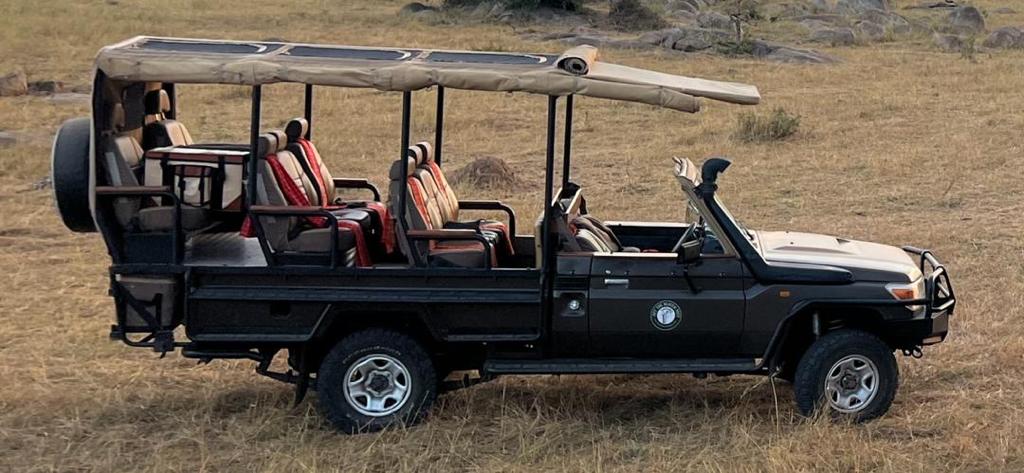
Space to photograph — Not just to sit
Photographers need space — not just for gear, but for movement, freedom, and flexibility. You’re often assigned a specific seat in a standard non-private safari vehicle. That’s fine for sightseeing. But not for photography.
On a private photo vehicle:
- Depending on the light and subject position, you can move from side to side.
- You’re not photographing over someone’s shoulder or through a support bar.
- Your tripod or beanbag setup stays ready, not packed away.
Anecdote:
In the Mara, I once watched a photographer with another group miss a cheetah hunt because she couldn’t get past another guest’s backpack wedged between the seats. Meanwhile, we repositioned effortlessly in my vehicle, giving each photographer space and clean sightlines. The difference in photos was night and day.
Control over timing and subjects
In a shared vehicle, the group’s priorities rule the day, and that group often isn’t made up of photographers. While you’re waiting for a lion to yawn or stretch into the perfect pose, someone else is tapping the guide’s shoulder, asking to move on because “we’ve seen enough lions and the pool at the camp is calling their name.”
With a private vehicle:
- You decide how long to stay at a sighting.
- You choose when to move and when to wait for better light.
- The day is planned around photographic goals, not general wildlife viewing.
Anecdote:
In Namibia, we once spent 45 minutes at a quiet waterhole with great late-afternoon light. Other vehicles came, snapped a few images, and left. We stayed. Ten minutes later, a herd of elephants arrived — one splashing and rearing up in golden light. My group got the cover-worthy photos. Everyone else missed the moment entirely.

Better communication with your guide
Guides make or break your experience, but it’s hard to collaborate when you’re in a full vehicle, shouting over engine noise and other guests. Your guide works with you in a private vehicle, not just driving.
- You can discuss animal behavior, lighting angles, and photographic goals on the fly.
- Your guide can position the vehicle specifically for clean backgrounds, ideal sun angles, or symmetry in composition.
- There’s time and trust to teach, explain, and adapt.
Tip:
A guide used to working with photographers knows to stop early, angle the vehicle for backlight, and wait quietly while you compose, not rush you.
Peace of mind for your gear
Let’s be honest: our gear isn’t cheap, and the last thing you want is someone knocking over your 600mm lens while reaching for a granola bar. In private vehicles:
- There’s space to store your equipment safely.
- You’re not wedging gear between knees or fumbling in cramped quarters.
- You can comfortably set up your workflow—one bag for cameras, one for lenses, a beanbag on the window, and a camera always at hand.
Anecdote:
In Etosha, a client who had travelled with me in the past was in a shared vehicle with another company. He came over to chat with us during a sundowner stop. His bag had been jostled underfoot and cracked his lens hood—he said he missed several photos that afternoon while dealing with the fallout. Our photographers? Relaxed, prepared, and grinning at the playback on their screens.
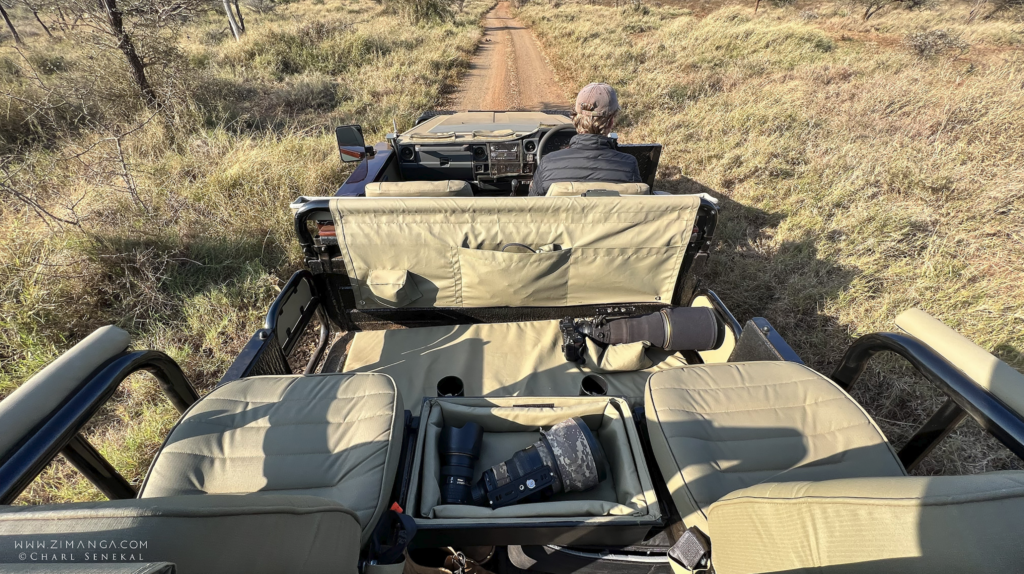
You paid for a photography safari — Not just a safari
You’ve likely traveled far. You’ve invested in camera gear. You’ve signed up for a dedicated photography experience. So why settle for compromises that prevent you from taking the best images possible?
Private vehicles aren’t a luxury — they’re a tool that helps you create the images you came for. They’re part of what separates a casual safari from a photographer’s safari.
At Akari Photo Tours, we never pack vehicles to the limit. Most of our safaris are run with:
- Three photographers per vehicle, so everyone has their own row.
- If there is an option to upgrade to specially outfitted photography vehicles, we will do that.
- You will always have a clear view on both sides of the vehicle.
You come for the photo. We make sure you get it.
Final thoughts: It’s your image. Don’t compromise it.
The difference between a good safari and a great photography safari often comes down to seconds—the few seconds when a leopard emerges, an elephant flares its ears, or the sun dips just low enough to kiss the acacia trees with gold.
You want to be ready when that moment comes.
You want space.
You want control.
You want a guide focused on your image, not the needs of a sightseeing crowd.
That’s what a private vehicle gives you. And once you’ve experienced it, you’ll never go back.
Come with us on one of our African photography safaris.