A Photographer’s Guide to Namibia’s Quiver Tree Forest
By Kevin Pepper |
What is the Quiver Tree Forest?
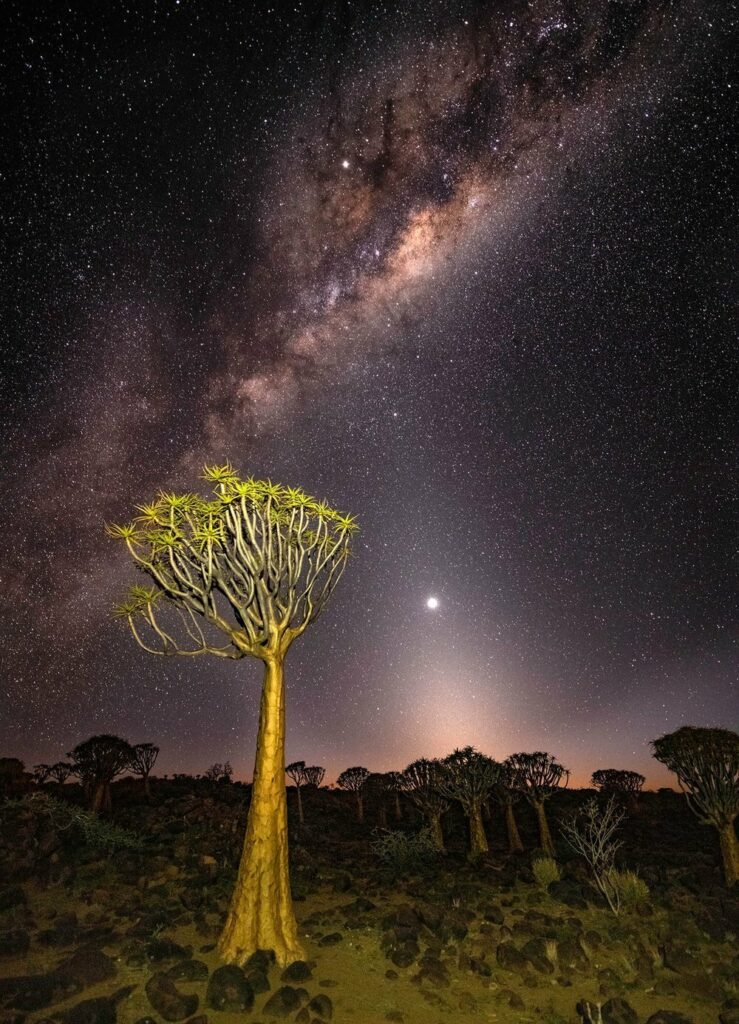
The Quiver Tree Forest, or Kokerboom Woud, is one of Namibia’s most surreal landscapes. Located near Keetmanshoop in southern Namibia, it has hundreds of towering aloe dichotoma trees—plants so otherworldly they look like a minimalist sculptor designed them. These trees can live up to 300 years, and their thick, split bark and golden branches glow under the right light, offering photographers a playground of texture, silhouette, and form.
Why is it called the Quiver Tree?
The name comes from the San people, who hollowed out the branches to make quivers for their arrows. These trees have been part of their survival and storytelling for generations. Though technically not trees—they’re a type of aloe—they stand like ancient sentinels in the desert, reaching toward the sky with arms that seem to hold history and mystery.
When is the best time to visit and photograph the Quiver Tree Forest?
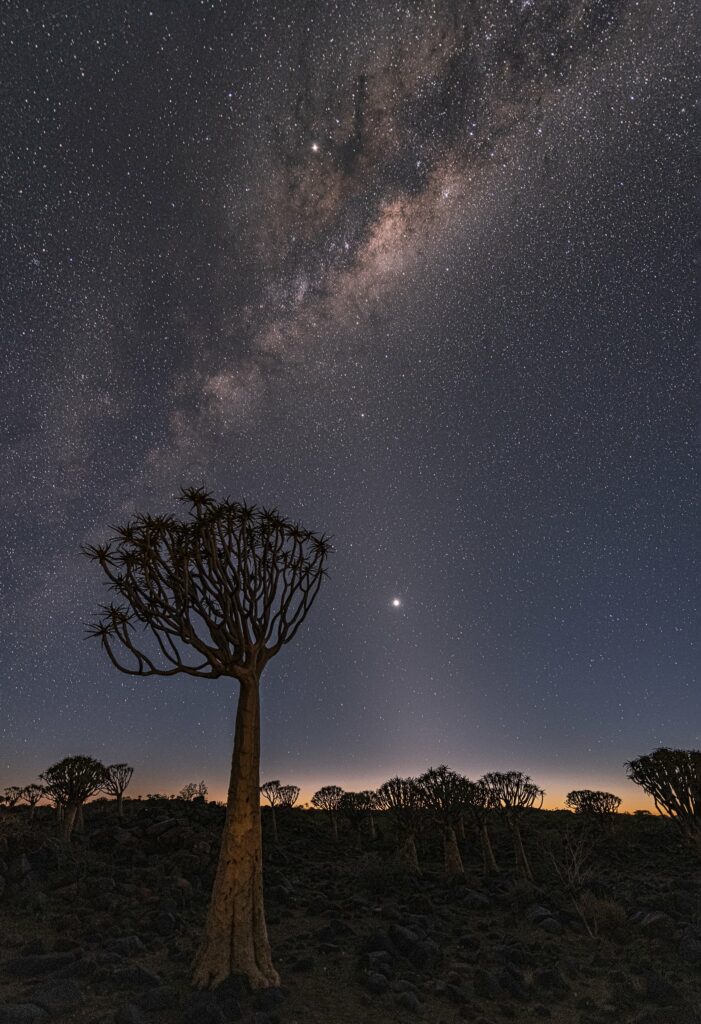
The magic of the Quiver Tree Forest happens in the golden hours—sunrise and sunset—when soft light wraps around the tree trunks, casting long shadows and bringing out warm tones in the bark. But don’t pack away your camera after dark. This location is a certified dark sky site, meaning the Milky Way cuts through the night like a river of stars. Quiver trees against a backdrop of southern constellations? It’s the stuff photographers dream of.
For the best conditions, visit between May and September when the skies are clearest and nights are crisp. Early morning light has a cooler tone, great for contrast. Evenings bring fire—rich color, dramatic skies, and a slow burn of light that makes every frame feel cinematic.
How to get to the Quiver Tree Forest
Traveling from Windhoek to the Quiver Tree Forest near Keetmanshoop offers a glimpse into Namibia’s vast and captivating landscapes. Here’s how you can make the journey:
By Car:
- Distance & Duration: The drive spans approximately 495 kilometers and typically takes around 4 hours and 40 minutes.
- Route:
- Begin on the B1 highway heading south from Windhoek
- Continue on the B1 directly to Keetmanshoop.
- From Keetmanshoop, take the M29 road northeast for about 13 kilometers to reach the Quiver Tree Forest Rest Camp.
- Road Conditions: The B1 is a well-maintained paved road suitable for all vehicle types. The M29 leading to the Quiver Tree Forest is also in good condition, but always check local travel advisories for any updates.
By Air:
- Flights: While there are flights from Windhoek’s Eros Airport (ERS) to Lüderitz Airport (LUD), this option is less direct. After landing in Lüderitz, you’d need to drive approximately 350 kilometers east to reach the Quiver Tree Forest, making this route less practical.
By Public Transport:
- Buses: Long-distance buses operate between Windhoek and Keetmanshoop. Upon arrival in Keetmanshoop, you can hire a taxi or arrange local transport to cover the remaining 13 kilometers to the Quiver Tree Forest.
Where to stay when visiting the Quiver Tree Forest
Choosing the right accommodation can significantly enhance your experience when photographing the Quiver Tree Forest. Here are some options to consider:
1. Quivertree Forest Rest Camp (My preferred location)
Located on the Gariganus farm, approximately 13 km northeast of Keetmanshoop along the M29 road, this rest camp is close to both the Quiver Tree Forest and the Giant’s Playground. Accommodation options include guest houses, igloo bungalows, a family room, and camping sites. Amenities feature air conditioning, private showers, fully equipped kitchens, and barbeque facilities. Please note that while dinner is available for guests booked on a dinner, bed, and breakfast basis, there is no open restaurant on-site. Camping is self-catering only.
2. Central Lodge
Situated in the heart of Keetmanshoop, Central Lodge provides comfortable rooms with en-suite bathrooms, air-conditioning, and Wi-Fi. Its central location offers easy access to local shops and restaurants, making it a convenient base for exploring the surrounding areas.
3. Schützenhaus Guesthouse
As one of the oldest German clubs in Namibia, Schützenhaus Guesthouse offers a blend of historical charm and modern comfort. Located in Keetmanshoop, it features en-suite rooms, a restaurant, a bar, and a swimming pool. The guesthouse is approximately 14 km from the Quiver Tree Forest.
4. Garas Park Rest Camp
About 20 km north of Keetmanshoop, Garas Park Rest Camp offers unique accommodations amidst a landscape dotted with quiver trees and intriguing rock formations. The camp provides camping facilities with barbeque areas, making it suitable for travelers seeking a rustic experience close to nature.
When selecting your accommodation, consider proximity to the Quiver Tree Forest, amenities offered, and the desired experience. Staying closer to the forest allows for easier access during optimal photography times, such as sunrise and sunset.
Tips for photographing the Quiver Tree Forest
1. Use light to sculpt, not just illuminate
- Low sun angles bring out the textures in bark and rock. Side lighting is your friend here.
- Try shooting into the sun for a starburst effect between branches.
- Stay after sunset—the twilight glow gives a cool, even tone perfect for wide landscape shots.
2. Compose for scale and simplicity
- Isolate a single tree with negative space to emphasize its shape.
- Use a person in the frame for scale, but place them carefully—too close, and they overpower the scene.
- Look for leading lines in cracked earth or rocky outcrops to draw the eye into the frame.
3. Don’t forget the stars
- Bring a sturdy tripod and a fast, wide-angle lens.
- Compose before it’s fully dark so you can frame your shot.
- Use a headlamp with a red light to protect your night vision.
3. Don’t forget to try light painting
- Bring different colored lights to paint the foreground trees.
- Compose before it’s fully dark so you can frame your shot.
- Use a headlamp with a red light to protect your night vision.
- Work in unison with your fellow travelers to avoid ruining each other’s shots.
Cultural and environmental Notes
While the Quiver Tree Forest is a protected site, it’s still fragile. Stay on designated paths, avoid climbing trees or disturbing rocks. These trees may be tough, but their ecosystem is delicate. The nearby Mesosaurus Fossil Site offers another chance to shoot ancient history—it’s worth the visit and complements the narrative of time and endurance the forest evokes.

Best camera gear for the Quiver Tree Forest
Camera Body
- Full-frame DSLR or mirrorless camera for optimal low-light performance.
- High ISO capability is key—especially for night skies.
- Weather sealing is a plus—nights get cold, and mornings can be dewy.
Recommended Bodies:
- Nikon Z6/Z7 or Z8
- Canon R6/R5
- Sony A7 III / A7R V
- Nikon D850 or Canon 5D Mark IV (if shooting DSLR)
Lenses
1. Wide-angle (essential)
- 14–24mm or 16–35mm f/2.8 for dramatic compositions and night sky.
- Fast aperture helps with the Milky Way and star shots.
2. Mid-Range Zoom
- 24–70mm f/2.8 for flexible compositions at golden hour.
- Great for isolating tree shapes while including context.
3. Telephoto (optional)
- 70–200mm f/2.8 or f/4 if you want compressed perspectives or detail shots of bark, branches, or people in the scene.
Tripod
- A solid and sturdy tripod is non-negotiable for long exposures and astrophotography.
- Ball head with a smooth action for fast re-framing.
Accessories
- Remote shutter release or intervalometer (to avoid shake).
- Headlamp with red light (to preserve night vision while setting up).
- Extra batteries (cold desert nights drain them fast).
- Lens cloths and a dust blower (dust and moisture can be an issue).
- Star tracker (optional for advanced astro work).
Filters
- Circular polarizer (for contrast and sky drama at sunset).
- ND filters (if you want long exposures at blue hour).
Bringing the right gear to the Quiver Tree Forest is about being ready for stunning natural light and deep night skies. It’s one of those places where every hour brings a new look—and the right tools help you keep up with the magic.
How we teach this in our workshops
✅ We guide you through shooting in golden hour and deep blue hour, helping you master transitions in natural light.
✅ We focus on slow photography—composition, storytelling, and patience, not just chasing the next frame.
✅ You’ll learn low-light techniques for astrophotography, from camera settings to post-processing workflows.
✅ We explore in small groups, allowing everyone to find their own angles and receive one-on-one coaching.
✅ We discuss creative storytelling—how to make a tree, a rock, or a shadow speak something more.
A photographer’s playground of light and time
The Quiver Tree Forest is unlike anywhere else in Namibia—and that’s saying something. It’s a place where ancient trees touch the stars, day fades into night, and every frame feels like a page from a forgotten story. The Quiver Tree forest should be on your “To-Do” list if you’re after silence, stillness, and unique images.
If you want to learn more about why Namibia is one of our favorite places on Earth, check out our articles on some of its most iconic locations—Spitzkoppe, often called the Matterhorn of Africa, the hauntingly beautiful ghost town of Kolmanskop, the Himba people of Namibia, the rich wildlife that roams its vast landscapes, and the surreal beauty of Deadvlei and Sossusvlei.
Each one offers a unique story and a reason to pick up your camera and join one of our Namibia Photo Tours. We will take care of all the logistics. You just have to show up and enjoy taking photos.